
Every mobile light tower lifts its lamps on a telescopic mast, but there are three ways to raise it: a manual hand winch, an electric winch or a hydraulic system. The right choice depends on how heavy the mast is, how often you move the tower and your budget. This guide explains the difference and when a hydraulic light tower is worth it.
One tower for each mast type
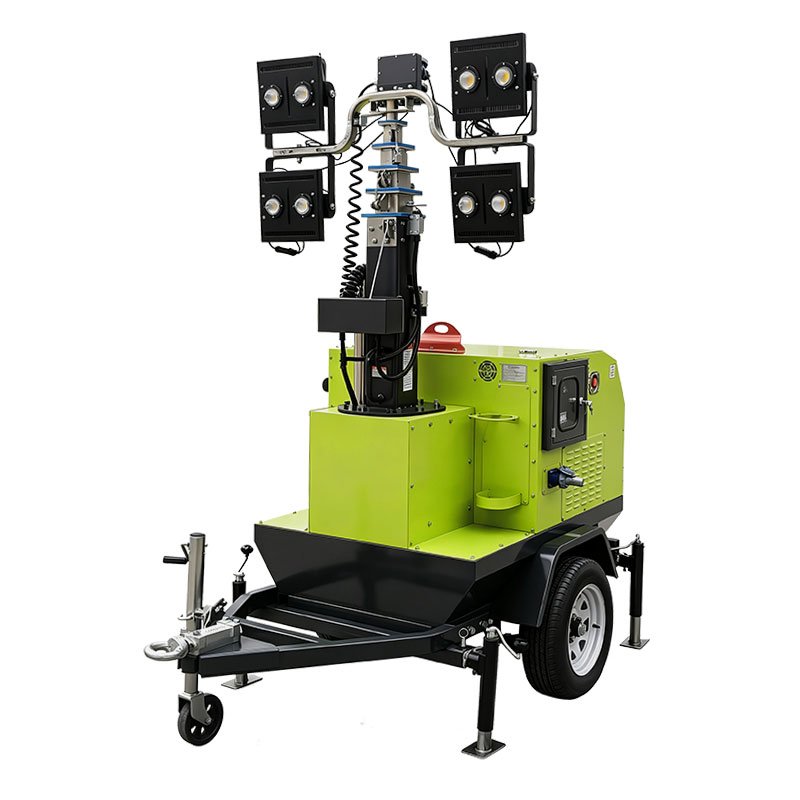
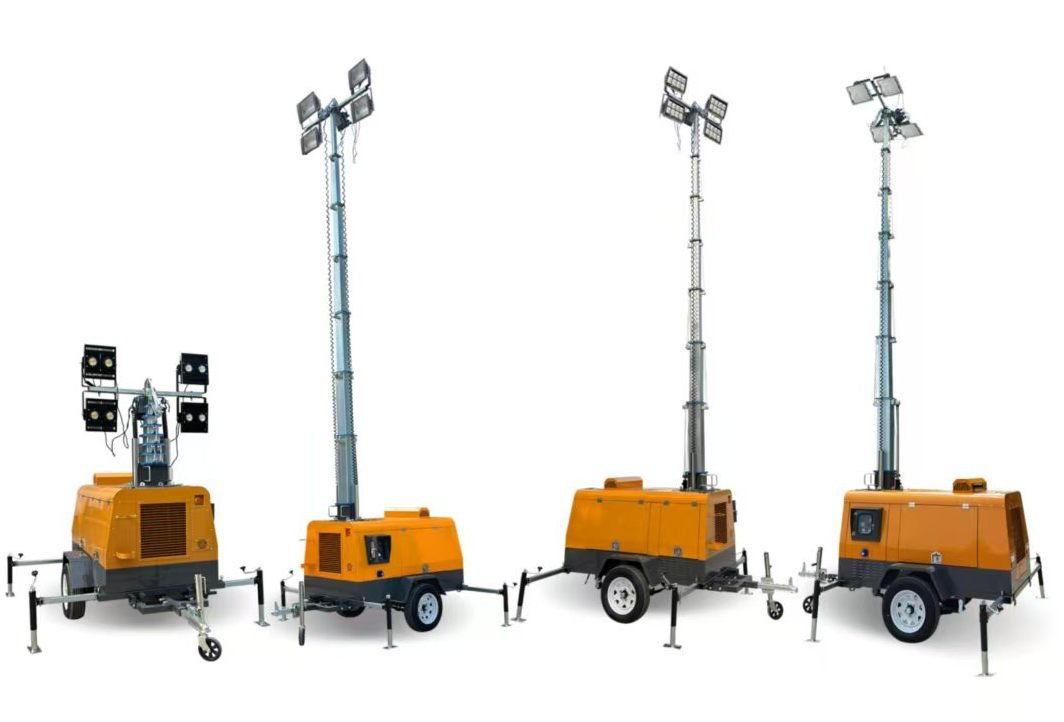 LFNVP4000
 4LT1600M9Z482
Manual, electric or hydraulic: quick comparison
| Manual winch | Electric | Hydraulic | |
|---|---|---|---|
| How it works | Hand crank and steel cable | Electric motor drives a winch | Hydraulic pump and cylinder push the mast up |
| Set-up effort | Physical work, several minutes | Push a button | Push a lever, smooth and fast |
| Best for | Light masts that stay in place for days | Rental fleets that move towers often | Heavy, thick masts and big lamp loads |
| Maintenance | Cable and winch check | Motor, switch and cable check | Hydraulic oil level, hoses and seals |
| Price | Lowest | Medium | Highest |
| LUMTA example | 4LT1600M9CC6.5KW | 4LT1600M9Z482 | LFNVP4000 |
When you need a hydraulic light tower
The heavier the mast, the harder it is to raise by hand. A tall mast that carries four 1,000 W metal halide floodlights and must stand in strong wind is built from thick, heavy steel sections. Cranking it up with a hand winch is slow, tiring work, and lowering it needs care. A hydraulic mast solves this: a pump and cylinder push the sections up smoothly when the operator moves a lever.
Choose hydraulic when:
- The mast is long and heavy (eight sections or more).
- Crews set up and move towers every shift, for example on mines, highway work or emergency sites.
- You want the safest, most controlled lowering of a heavy lamp head.
Our LFNVP4000 hydraulic light tower is built for this: an eight-section galvanized 9 m mast raised hydraulically, four 1,000 W metal halide floodlights (440,000 lm, about 300 m beam) or four 400 W LED, a 90 L tank for up to 65 hours, and your choice of Kubota, Yanmar, Changchai or FAW Xichai engine. The whole machine weighs about 1.2 tonnes.
When an electric mast is enough
An electric winch gives push-button set-up at a lower price than hydraulics. It suits rental fleets that move towers often but carry a standard lamp load. The 4LT1600M9Z482 raises its six-section 9 m mast electrically and runs up to 68 hours on a Kubota Z482 engine.
When a manual winch makes sense
A self-braking hand winch is simple, reliable and the lowest-cost option. It is a good fit where towers stay in one place for days, or where the buyer wants the fewest parts to maintain. The 4LT1600M9CC6.5KW (Changchai, 6.5 kW generator) and 4LT1600M9BAT8KW (ANMAX 8 kW generator) both use a 9 m winch mast. For tight sites, the WK1600M5 walk-behind tower uses a 4.8 m hand-crank mast.
Maintenance tips for each mast type
- Manual winch: check the steel cable for wear and keep the winch brake clean.
- Electric: check the motor, up/down switch and cable; keep connectors dry.
- Hydraulic: check the oil level, hoses and cylinder seals; ask for a manual release valve to lower the mast without engine power.
See our light tower maintenance and service kit guide for the full schedule.
Hydraulic light tower FAQ
Why do some light towers use a hydraulic mast?
Large towers with thick, heavy masts are hard to raise by hand. A hydraulic system lifts the mast smoothly at the push of a lever, so one operator can set up the tower in about a minute and lower it safely at the end of the shift.
Is a hydraulic mast better than a manual winch?
For heavy masts and frequent moves, yes: it is faster and less tiring. A manual winch is simpler, costs less and needs no hydraulic oil, so it suits towers that stay in one place for days.
How high do hydraulic light tower masts go?
Our LFNVP4000 hydraulic tower lifts an eight-section mast to 9 m.
Can I lower the mast if the engine stops?
Ask for the manual release on the hydraulic system so the mast can be lowered safely without engine power.
Which mast type is cheapest?
A manual hand-winch mast, such as on the 4LT1600M9CC6.5KW. Electric and hydraulic masts cost more but save time on every set-up.
Get a factory quote from LUMTA
Send your application, quantity and destination port. MOQ 1 unit, production 45–60 days, 12-month warranty, ISO 9001:2015 factory. FOB or CIF quote within 24 hours.