
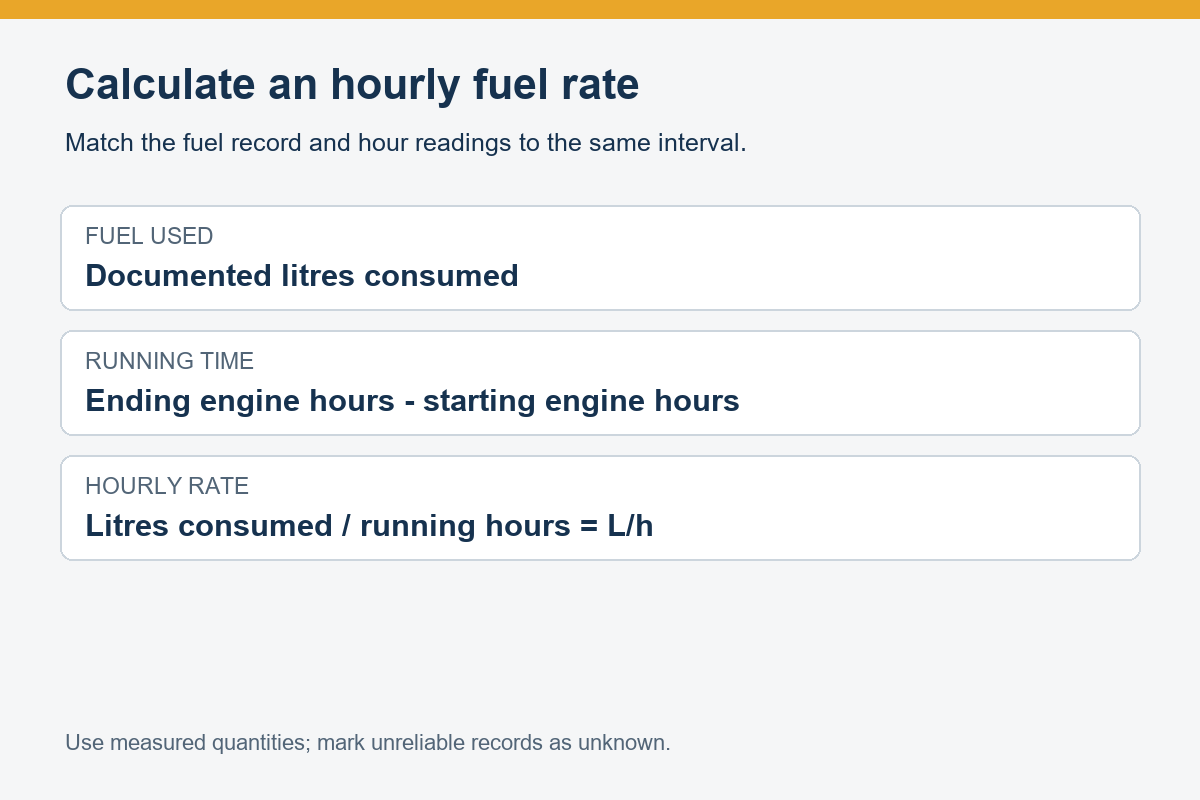
Recordkeeping diagram; not a product photograph or measured performance result.
How to establish a usable hourly rate
Use a light tower fuel consumption log to record fuel used and engine running hours over the same interval.
Measure diesel light tower fuel consumption by recording fuel used and engine running hours over the same interval. Divide litres used by running hours to obtain an average in L/h. Keep the model, lamps, auxiliary loads and site conditions with that result; a number without those conditions is a weak basis for a purchase or fuel budget.
Start with a fuel-use total from a documented, suitable measurement system. If you use tank records instead, you need opening and closing fuel quantities plus every addition or removal. A purchase receipt alone records fuel delivered, not necessarily fuel burned by one tower during one shift. EPA’s historical fuel-accounting Q&A explains why deliveries require adjustment for opening and closing inventories. We apply that accounting principle here to a machine log; it is not a current regulatory requirement or a certified light-tower test. Source: EPA fuel-accounting Q&A.
This guide provides a recordkeeping method and an illustrative calculation. It is not a certified performance test, a fuel-system modification procedure or a claimed LUMTA field result. Use the operating and refuelling instructions for the exact tower. For endurance estimates after you have a usable consumption figure, see the diesel light tower runtime guide.
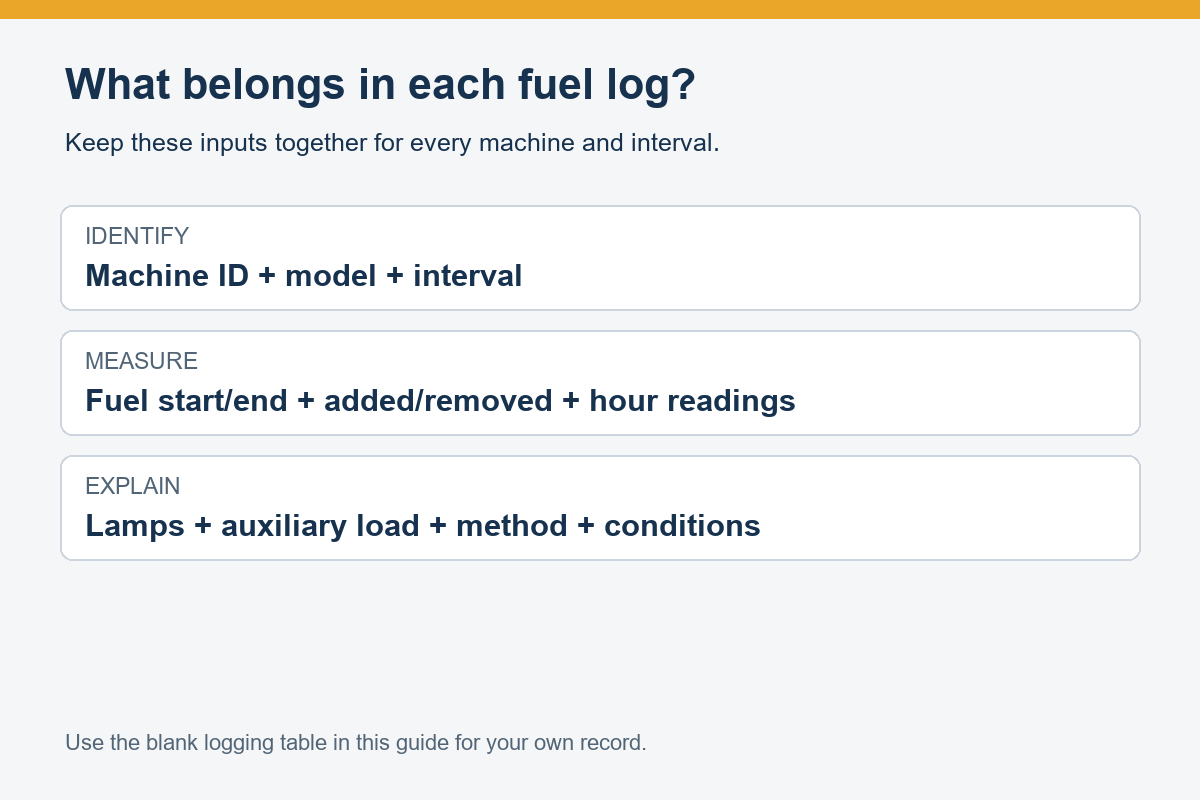
Recordkeeping diagram; not a product photograph or measured performance result.
Record the machine, fuel and running time together
Use one record per machine and logging interval. Keep site-wide fuel deliveries separate; combining several towers hides where a change occurred. Read the engine-hour counter instead of using scheduled shift length, which can include time when the engine is off.
| Field | What to enter | Why it matters |
|---|---|---|
| Machine identification | Fleet ID, exact model, engine and configuration revision | Keeps different configurations separate |
| Interval | Start/end date and time | Matches the fuel record to the operating period |
| Running time | Opening and closing engine-hour readings; meter source | Excludes shutdown time from the denominator |
| Fuel measurement | Metered consumption, or opening/closing quantities and method | Shows whether the result is measured or estimated |
| Fuel movements | Each addition, drain or transfer and its quantity | Prevents delivered fuel being confused with burned fuel |
| Lighting load | Lamps active, their ratings and operating schedule | Identifies the lighting duty being compared |
| Auxiliary equipment | Equipment connected and its duty cycle | Accounts for generator work beyond lighting |
| Conditions | Relevant weather/site notes, maintenance status and interruptions | Helps explain results that may not transfer to another shift |
Blank logging row:
| Unit / interval | Hours start / end | Fuel start / end | Added / removed | Lamps / auxiliary load | Measurement method / notes |
|---|---|---|---|---|---|
| ______ | ______ / ______ | ______ / ______ | ______ / ______ | ______ | ______ |
A dashboard percentage is not automatically an accurate volume in litres. If you cannot establish usable fuel quantities from a documented measurement method, retain the readings as observations and mark consumption as estimated or unknown. Do not convert “half a tank” into a precise burn rate simply by multiplying nominal tank capacity.
For telemetry-equipped machines, check which counter is displayed, its units and its reset period. Save the starting reading before resetting anything. This record does not require retrofitting a flow meter or opening fuel lines.
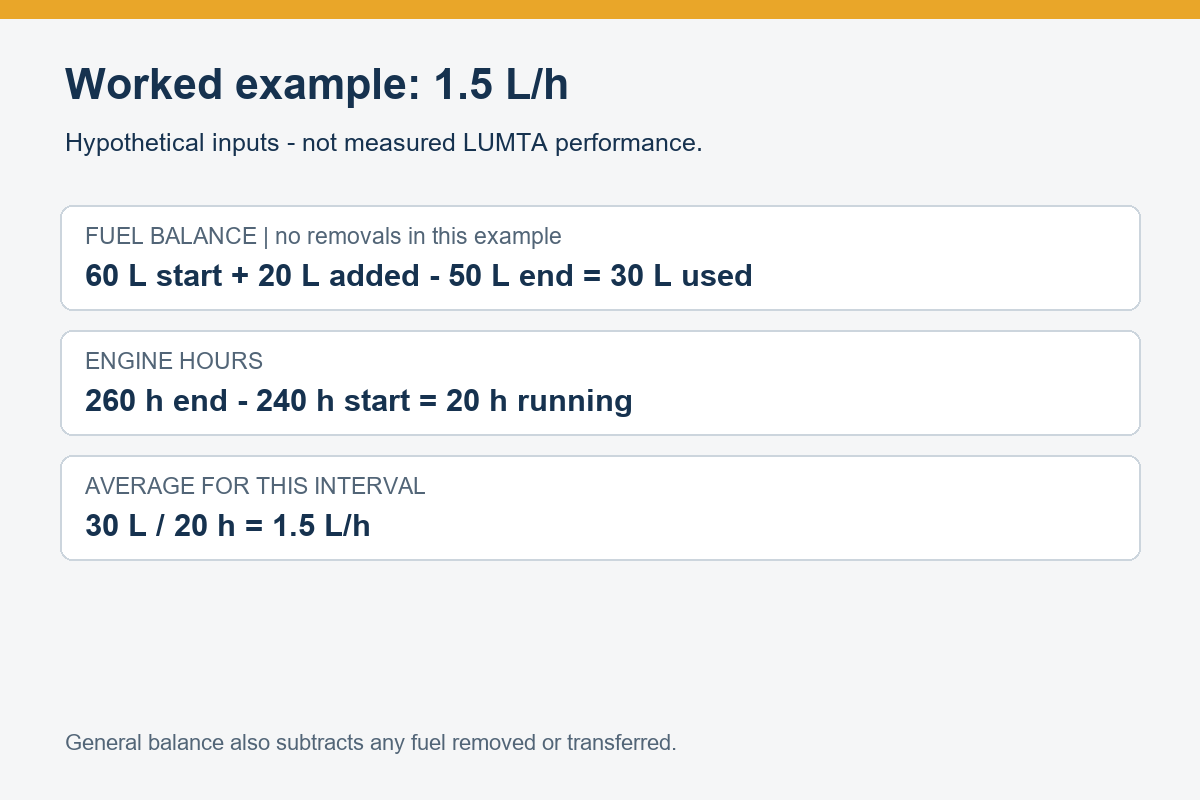
Recordkeeping diagram; not a product photograph or measured performance result.
Calculate fuel use and check the interval
- Confirm that the start/end quantities, fuel movements and hour readings belong to the same machine and interval.
- Reconcile the fuel inventory using the equation below.
- Subtract the starting engine-hour reading from the ending reading.
- Divide accounted fuel by running hours, then verify the transactions and conditions before reusing the result.
For a tank-balance record, the accounting calculation is:
Fuel used = opening fuel + fuel added − closing fuel − documented fuel removed.
Average hourly consumption = fuel used ÷ engine running hours.
The first calculation accounts for fuel leaving the recorded inventory. It represents engine consumption only when leaks, unrecorded transfers and other losses have been ruled out. Use consistent units and comparable opening/closing measurement conditions. Never deliberately run a tower dry to obtain an endpoint.
Worked example — illustrative inputs
| Input | Example |
|---|---|
| Opening measured fuel | 60 L |
| Added during the interval | 20 L |
| Closing measured fuel | 50 L |
| Recorded removals | 0 L |
| Engine hours: opening → closing | 240 → 260 h |
Fuel accounted for is 60 + 20 − 50 = 30 L. Running time is 260 − 240 = 20 hours. Average use is 30 ÷ 20 = 1.5 L/h, assuming the quantities are reliable and there are no other losses. These values demonstrate arithmetic; they are not specifications for any LUMTA model.
Before using a result, reconcile it with the fuel transactions and machine ID. A missing refill, meter reset, unknown transfer or non-positive running-time interval needs correction. If the record shows an unexplained fuel loss, follow the machine’s inspection instructions and refer it to qualified service personnel; the log cannot diagnose the cause. Use the light tower maintenance and troubleshooting checklist to organise inspection records.
For several comparable intervals, divide their total fuel use by their total running hours. This weights the result by time. Keep different load configurations separate; combining them may describe the fleet’s total duty cycle but obscures each configuration’s consumption.
Turn the rate into a shift estimate
Using the illustrative 1.5 L/h result, three towers operating for ten hours would require 1.5 × 10 × 3 = 45 L, before a separately planned reserve. The estimate is useful only if the next shift has reasonably comparable loads and conditions. Agree the reserve and refuelling arrangement with the site’s operating plan; this guide does not prescribe a universal reserve percentage.
If loads change during the night and you cannot measure fuel separately for each segment, label the result as a mixed-duty average. Do not report it as a lights-only or full-generator-load test.
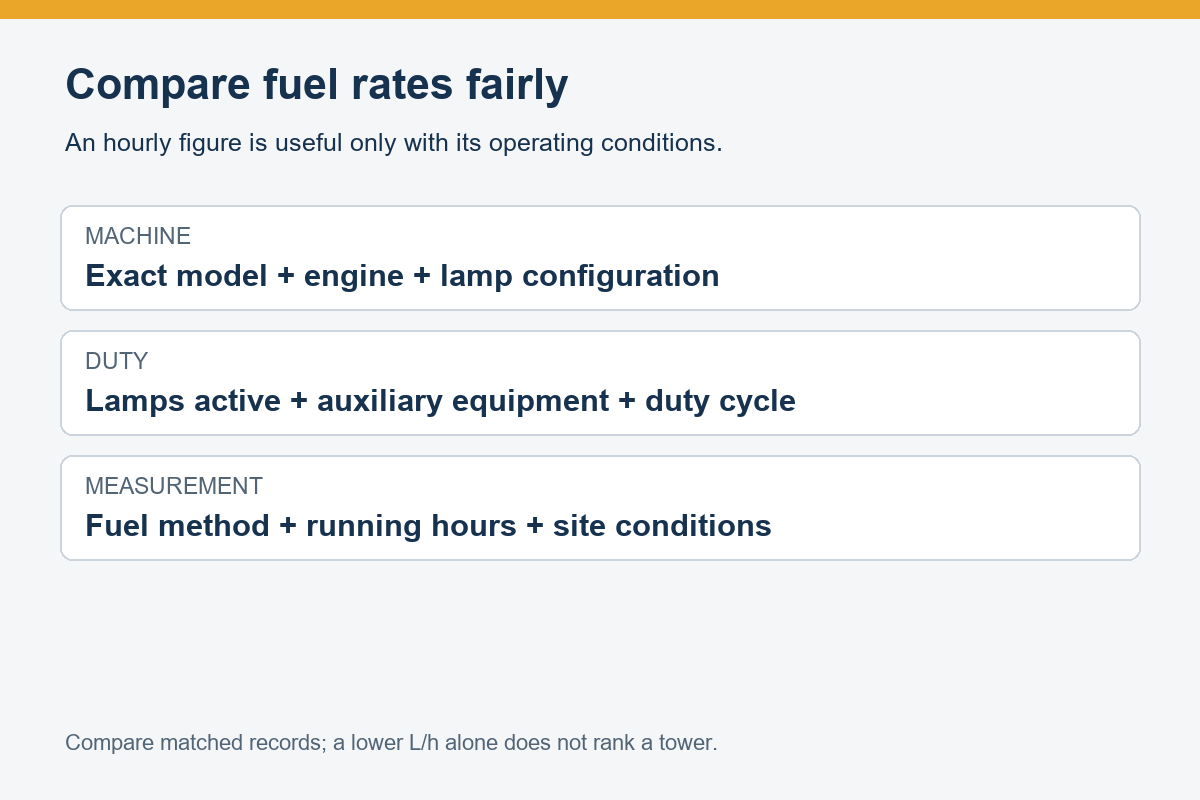
Recordkeeping diagram; not a product photograph or measured performance result.
Compare supplier data under matching conditions
Ask the supplier to identify the exact engine, tank, lamp configuration, active auxiliary loads and measurement basis behind a fuel figure. “Full load” should identify which rated output and test arrangement were used. Running all lamps does not necessarily load the generator to its full electrical rating.
A historical example shows why the distinction matters. Generac’s 2022 MLT4000-series sheet lists separate lights-only and full-load consumption rows. For its MLT4060KVLED configuration, it reports 1.16 L/h with lights only and 2.46 L/h at full load. These are manufacturer-reported values for that configuration and document revision, not a benchmark or specification for LUMTA. The sheet also identifies a break-in condition and cautions that age, maintenance, environment and fuel density can affect results. Source: Generac historical specification sheet.
| Comparison question | A usable answer |
|---|---|
| Which machine? | Exact model, engine and configuration |
| Which duty? | Lights operating, auxiliary loads and schedule |
| Which fuel basis? | Measured consumption or calculation; units and interval |
| Which operating conditions? | Relevant test/site conditions and equipment status |
| Which evidence? | Dated specification, test record or documented counter data |
If your site record differs from the quotation, align those fields first. A disagreement under different loads does not establish a defect or a false quotation. If the conditions match and the difference remains unexplained, send the record and measurement details to the supplier for review.
For a rental fleet, retain valid records by model and duty rather than selecting whichever single shift gives the lowest figure. A short trial does not demonstrate seasonal performance, long-term maintenance cost or reliability.
Fuel consumption log FAQ
Can I calculate consumption from the amount bought?
Only when that fuel quantity belongs to the same machine and interval and the opening/closing inventory and other fuel movements reconcile. Fuel bought for a site may also supply other equipment or remain in storage.
Should I use scheduled shift hours or engine hours?
Use engine running hours for an hourly burn rate. Keep the scheduled shift separately for fuel-delivery planning, including shutdowns and overtime.
Does a lower L/h figure always mean a better light tower?
Compare the work delivered as well as fuel use. Different lamp loads, auxiliary power and illumination requirements can make two rates unsuitable for direct ranking.
What if I cannot measure the remaining fuel reliably?
Do not present a precise tank-balance result. Ask which documented measurement or consumption-counter method is suitable for the exact configuration, and preserve the existing observations with their limitations.
Use the log in your next equipment enquiry
Review the diesel mobile light tower range and send the preferred model, quantity, delivery destination, hours per night, lamps required and auxiliary loads. If you already operate a comparable tower, include the log and measurement method so the fuel question has a clear basis.
Request configuration-specific fuel data and a project quote. For the rest of the enquiry, use the mobile light tower quotation checklist.