
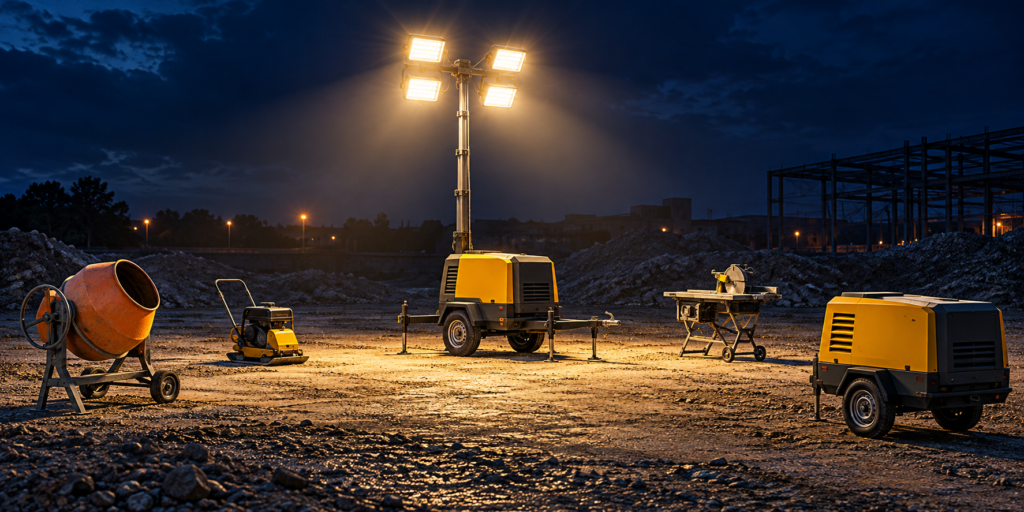
Illustration only; do not infer that the separate equipment can be powered by a quoted tower.
Diesel light tower generator sizing starts with the actual electrical load. Lamp wattage alone does not tell you what generator a mobile light tower needs or how much power remains at an accessory outlet. First identify the quoted generator set’s electrical rating and duty class. Then list loads that can run at the same time, check starting or step loads, and ask the supplier to confirm the operating limits for that exact configuration. Engine horsepower is not the same as generator electrical output.
This guide helps buyers and project engineers compare equipment for repeated night shifts. Its numbers are examples, not measured LUMTA product performance.
Need a light tower that also powers site tools?
Tell us your lamp load and the tools you want to run; we size the generator and quote FOB/CIF within 24 hours.
- 4LT1600M9Z482: lighting only, Kubota Z482, up to 68 h per tank
- 4LT1600M9CC6.5KW: Changchai water-cooled diesel, 9 m mast, up to 68 h per tank
- 4LT1600M9BAT8KW: light tower with an 8 kW generator
Read the complete generator-set rating
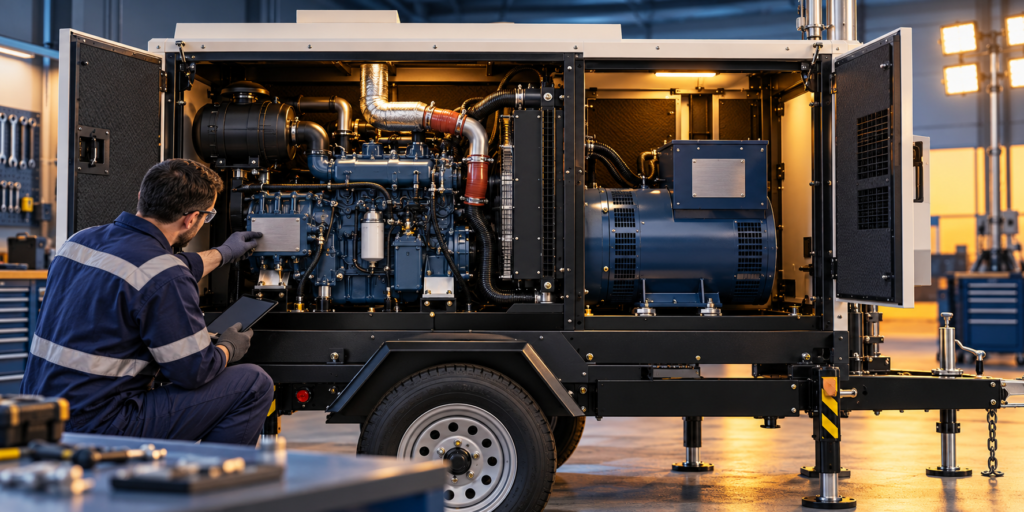
Illustration only; check the exact engine, alternator and complete-set rating in the quotation.
A generator-output claim is incomplete without its rating basis. Prime, standby and continuous ratings correspond to different duty patterns and manufacturer conditions. Prime generally applies to a variable load used as a primary power source; standby applies to interruption of normal power; continuous applies to a defined steady duty. Permitted average load, operating hours and overload allowance depend on the specific rating and manual. Do not assume every nameplate number is a short-time peak or infer a fixed conversion between duty ratings.
Separate the engine’s mechanical output from the generator package’s electrical output. PNNL explains the engine and generator as distinct components; its standby-generator overview supplies a general mechanical-to-electrical distinction, not a light-tower rating. An engine model name alone does not establish any LUMTA light tower’s outlet rating. Ask for the quoted set’s alternator/generator identification, electrical kW and kVA, power factor, voltage, frequency and duty rating.
An alternator sheet is useful evidence, but it still needs to match the machine being quoted. For example, the customer-supplied Sinocox SMU132 series sheet lists variant-specific output under separate single-phase and three-phase conditions. Those are component ratings, not confirmation that a LUMTA model uses that alternator or can deliver its stated power at the sockets. Match the exact alternator variant and connection to the engine, controls and complete-set rating.
If a supplier states only kVA, obtain its specified power factor and corresponding kW. The conversion depends on the documented rating conditions; it is not a reason to apply an assumed fixed reduction to every generator’s kW value.
Count simultaneous loads, not everything installed
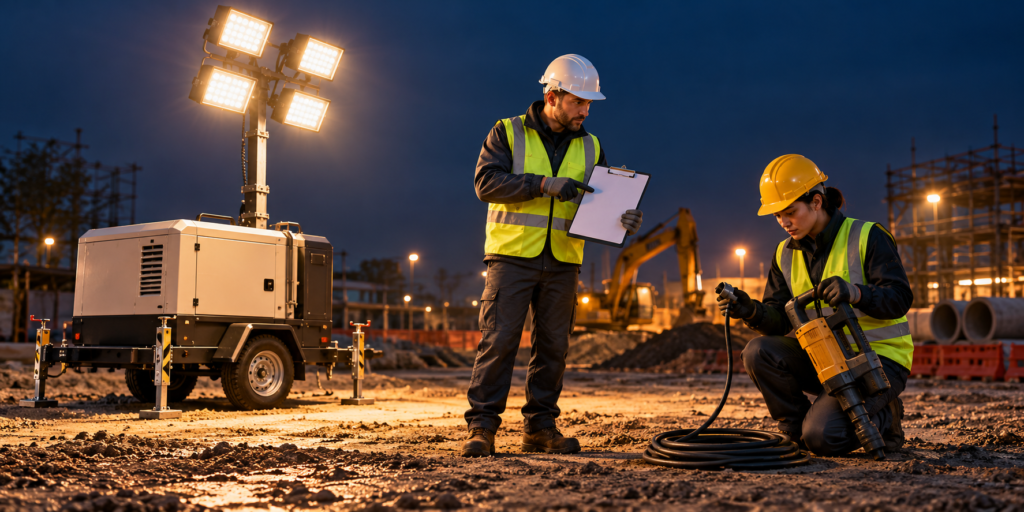
Illustration only; the tool shown is not a confirmed compatible accessory.
Start with each LED fixture’s documented AC input, including its driver. Add accessories only when the generator actually powers them at the same time: for example, an approved tool, camera system or battery charger if supplied or connected. A mast motor may operate during setup rather than during full lighting; verify the sequence instead of assuming all installed components run together.
Record running demand and starting or inrush demand for motors and chargers. FEMA’s generator-sizing appendix explains why the peak case combines a starting load with equipment already running and why switching sequence matters. It discusses emergency or alternate-power systems; use that principle to frame a load schedule, not as a tested light-tower capacity. Record load type, running kW/kVA and starting requirements. An outlet’s circuit rating is not necessarily spare generator power when the lights are on. Breakers, wiring, voltage, alternator capacity and site conditions can impose tighter limits.
Worked example: four 400 W lamps

Illustration only; the figures below are hypothetical arithmetic, not measured equipment output.
This is a hypothetical worksheet, not a test result or rating for a LUMTA model.
| Input | Example | What it tells you |
|---|---|---|
| LED lamps | 4 × 400 W = 1,600 W nominal | A starting estimate for lighting input; check fixture/driver data |
| Quoted set | Suppose it has a documented 5 kW electrical prime rating | A denominator for this example only; do not infer it from engine horsepower |
| Lamps alone | 1.6 ÷ 5 = 32% | A lighting-only ratio, not total operating load |
| Additional device | Suppose one device draws 600 W with all lamps on | The simple steady sum is 2.2 kW; check other loads and transients separately |
| Duty and site | Hours/night, temperature, altitude, voltage and frequency | Conditions needed to apply the manufacturer’s rating and any derating |
The 2.2 kW sum does not prove available socket capacity, motor-starting kVA, fuel consumption or service life. A charger can cycle; a mast motor may run at another time. Too little capacity may fail a concurrent start, while a much larger diesel set may spend long shifts lightly loaded. FEMA’s emergency-power sizing appendix discusses both limits in its own application context; it does not define an optimal size for a LUMTA tower. The supplier should validate the actual load sequence against the offered set.
Is 70% the best load for a diesel light tower generator?
There is no universal best-load percentage for every light tower. Operating guidance depends on the specific engine-generator package, duty rating and application. FEMA’s generator-sizing appendix discusses the consequences of both insufficient capacity and sustained low loading in its emergency-power context. It does not prove that a particular LUMTA light tower lasts longest within a fixed load band or that a single threshold applies to its engine.
For a purchase decision, calculate the expected electrical load divided by the matching electrical rating only as a screening ratio. Then check the proposed engine-generator manufacturer’s permitted loading and duty guidance, expected hours at each load, and any auxiliary or intermittent demand. The lowest-load case matters too: a fleet using only some lamps on long shifts may operate differently from a full-lighting example. If the relevant operating guidance is unavailable, do not label any calculated percentage “optimal”; request the exact matched package and its manual or a supplier engineering review.
Need a generator-set proposal for your project? Send the lamp quantity, nightly hours and any equipment that must share power. You can leave the generator model blank; LUMTA can identify what must be confirmed in the written quotation.
Five checks before approving a configuration
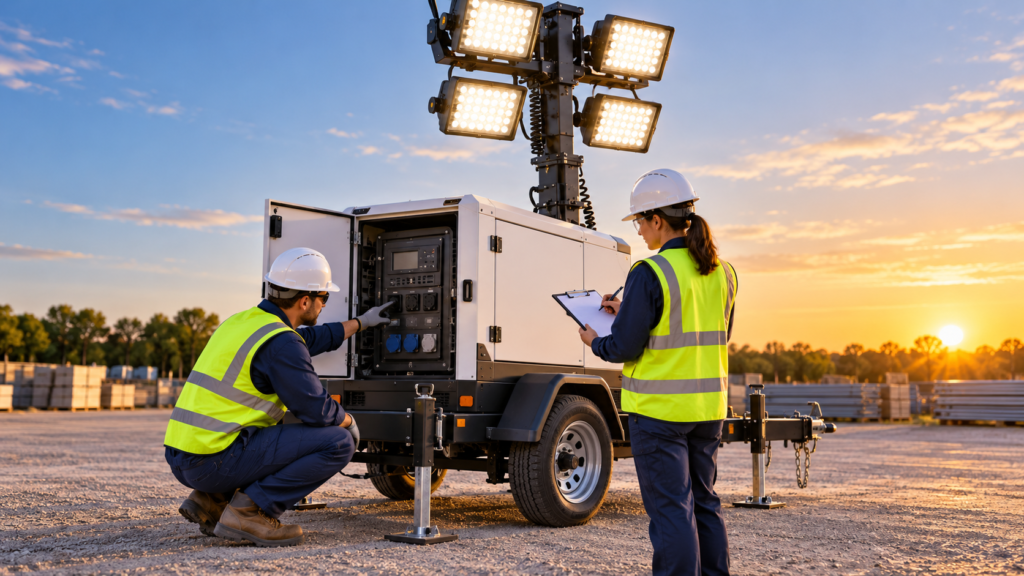
Illustration only; the panel does not represent a LUMTA product specification.
- Define the lighting task. State fixture quantity and AC input, which circuits operate together, required illumination and hours per night. Fewer active lamps also mean less light on site.
- List extra electrical loads. For tools, chargers, cameras or other devices, record running watts, start/step demand and whether each overlaps with full lighting. Say “none” if no external supply is needed.
- Request comparable rating data. Ask for the exact engine and generator-set package, electrical prime/continuous and standby ratings where relevant, kW, kVA, rated power factor, voltage, frequency and allowed accessory load with the required lights on.
- Describe site conditions and sequence. Provide temperature, altitude, shift length and starting order. Ask whether derating or transient voltage dip changes the proposal.
- Verify the offered version in writing. Match lamps, outlets, breakers, load limits and manuals to the quoted package. If auxiliary power is critical, request a suitable combined-load demonstration or test report.
Use this short enquiry schedule so competing proposals answer the same question:
| Send to the supplier | What to enter |
|---|---|
| Project and supply | Country, site temperature and altitude, voltage, frequency and phase |
| Lighting | Fixture quantity, documented AC input per fixture, and how many run together |
| Other loads | Device, running W or kW, starting demand if relevant, and when it runs |
| Duty | Hours per night, days per week, and whether reduced-light operation is planned |
| Required evidence | Exact engine and alternator variants, electrical prime/continuous rating, permitted load with lights on, outlet protection and operating manual |
This sizing decision differs from the fuel-use and runtime calculation. Sizing asks whether the set supports the required load; runtime asks how long usable fuel supports operation at a stated load.
Common buyer questions
Do four 400 W lamps need exactly a 1.6 kW generator?
No. The nominal 1.6 kW lighting sum is only one input. Actual fixture input, simultaneous accessories, starting demand, duty class and site conditions also matter. Ask the supplier to check the complete load schedule.
Can I subtract lamp watts from generator kW to find spare outlet power?
Only as a first screening calculation when the figures are comparable electrical kW values. It does not validate the outlet circuit, transients, power factor or derating. Request the permissible external load while all required lamps operate.
Is 70% always the best diesel-generator load?
No. A permissible average load under one rating is not automatically the most efficient point or the longest-life setting for every machine. Use the supplied set’s published operating instructions.
Does “Kubota Z482” tell me the electrical output?
No. It identifies an engine family. The matched alternator, engine variant and speed, electrical rating and controls still have to be specified.
Compare the package that will actually be supplied
Review LUMTA diesel mobile light tower options by mast and lamp configuration. If you have not chosen an energy system, start with the mobile light tower range; the mobile light tower guides cover adjacent planning questions. To describe your project, start a guided enquiry with the lighting task, nightly hours, quantity, destination and anything that must share generator power. “Not sure” is an acceptable answer; the written quotation should identify the exact electrical package and permitted loads.
Technical sources:
- FEMA generator-sizing appendix and PNNL generator overview explain general principles in emergency or standby contexts.
The Sinocox SMU132 Rev.E sheet was supplied by the customer. Its figures must be matched to the actual quoted component before they are used as a product specification.
For a structured procurement checklist, see our diesel light tower buying guide covering configuration and sourcing.
Sourcing for a project or tender? Send us your RFQ
Procurement teams, EPC contractors and rental fleets can send their RFQ straight to our factory. Your spec sheet may list another brand’s model: send it anyway and we will quote the matching LUMTA model.
Please include:
- RFQ or tender number and closing date
- Quantity
- Required specifications, or the model on your spec sheet
- Destination port and Incoterm (FOB or CIF)
- Voltage and frequency at site
Within 24 hours you receive:
- Written quotation (FOB or CIF)
- Datasheet of the offered model
- Product photos and videos
- Production lead time, packing and container loading details
Upload your RFQ in the form belowsales@lfadjlight.comWhatsApp
Get a factory quote from LUMTA
Send your application, quantity and destination port. MOQ 1 unit, production 45–60 days, 12-month warranty, ISO 9001:2015 factory. FOB or CIF quote within 24 hours.