S971 Solar Manual Winch Mobile Light Tower
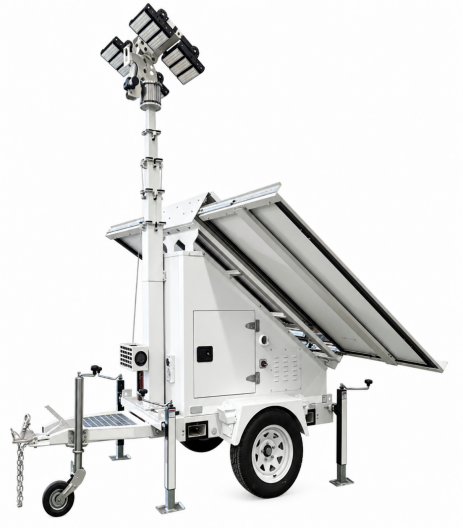
A zero-fuel mobile lighting platform for construction, emergency response, road maintenance, farms, military support and outdoor events. The S971 combines four efficient LED floodlights, electric solar-panel deployment and a towable stabilized chassis.
Choosing the S971 Solar Light Tower for Your Australian Project
The S971 combines a 7 m manual mast, four 100 W LED lamps and three 400 W solar panels. When comparing complete solar lighting towers for your Australian project, check whether this mast height and lighting arrangement fit the work area and available deployment space.
Provide the site postcode or coordinates, work-area length and width, required illuminance (lux, if specified), proposed tower positions and any glare-sensitive boundaries. Include operating months, full-output lighting hours, any requested dimming periods and the required reserve during low-sun periods. Identify shading and camera or communications loads. Ask the quotation to confirm the lighting arrangement, control functions, battery configuration and usable energy for that schedule.
For shipping, provide the delivery address or destination port and unloading equipment. Confirm packed dimensions, shipment weight, any assembly on arrival and the proposed container quantity against the final packing plan.
Compare solar lighting towers and Australian project requirements
Request an S971 Project Quote | Send S971 Requirements on WhatsApp
Practical solar lighting for demanding sites
The S971 is designed for rapid deployment, flexible logistics and straightforward day-to-day operation.
Solar powered
Operates without routine fuel consumption during normal solar lighting use.
Electric panel deployment
Sliding solar array with electric adjustment from 0° to 65° for site setup.
Flexible loading
Six forklift pockets support practical handling and transport operations.
Strong outriggers
Four stabilizers help secure the trailer on demanding temporary work sites.
Independent lamp control
Individual floodlight control supports flexible use and convenient maintenance.
Remote-site deployment
Towable chassis and compact packed size support relocation between work areas.
Optional 4G/App Remote Control for S971
Configure the S971 with an optional 4G/App module for remote lamp switching and viewing of equipment operating status. Include the communications module in the project energy review alongside the lighting schedule and any other auxiliary equipment.
This is a non-standard custom option, quoted separately from the base configuration. Provide the destination and mobile coverage, then confirm the operating-status fields, access arrangements and any SIM/data or platform charges. See our remote-management configuration checklist.
Request S971 with Remote ControlSend S971 Remote-Control Requirements
S971 specifications
Current lighting configuration: 400 W total LED power and 1,200 W rated solar capacity. Confirm packed dimensions, weight and component details for the quoted configuration.
| Rated voltage | DC 24 V |
|---|---|
| LED power | 4 × 100 W |
| Expanded size | 3400 × 3100 × 7000 mm |
| Packing size | 2300 × 1350 × 2300/2600 mm |
| Machine weight | 980 kg |
| Container loading | 20 ft container: 4 units / 40 ft container: 8 units; final packing plan to confirm |
| Solar panels | 3 × 400 W |
| Panel tilt | 0–65° |
| Panel extension | Sliding, electric deployment |
| Battery | 4 × 200 Ah gel; individual battery voltage and wiring to confirm before calculating total energy |
| Lamp voltage | DC 24 V |
| Colour temperature | 4000–4500 K |
| Ingress protection | IP65 |
| Mast type | Manual |
| Mast material | Carbon steel |
| Surface finish | Electrophoretic coating + powder coating |
| Maximum mast height | 7 m |
| Lamp tilt | 0–90° electric |
| Trailer capacity | 1200 kg |
| Maximum towing speed | 85 km/h |
Specifications are based on the supplied product data. Lighting duration and charging performance vary with solar conditions, lamp use, battery condition, temperature and site environment. Confirm the final project configuration with LUMTA before ordering.
Four steps from arrival to illumination
A straightforward layout helps crews establish temporary lighting efficiently.
Position
Park the trailer and deploy the four stabilizers on suitable ground.
Open solar array
Extend the sliding panels and adjust their angle between 0° and 65°.
Raise the mast
Use the manual mast system to reach the required height, up to 7 m.
Aim the lamps
Adjust and control the four LED floodlights for the required work area.
Mobile lighting across temporary work environments
Frequently asked questions about S971 Solar
Can the S971 provide lighting after sunset?
Yes. Solar energy is stored in the battery for night operation, but usable runtime depends on the confirmed lighting load, battery capacity, charging conditions, season and reserve target.
How are the solar panel and battery configuration selected?
Selection starts with nightly operating hours, floodlight load, local solar resource, seasonal conditions, required autonomy and any backup-power strategy.
Can cameras or communications equipment be added to S971?
Auxiliary equipment can be reviewed as a project option. Every camera, router, modem or sensor must be included in the energy calculation and final configuration.
What information is needed to select an S971 solar light tower for cold weather?
Provide the site location, minimum temperature, operating months and required lighting hours per night. Ask LUMTA to confirm battery charging and discharge temperature limits, usable energy and the required low-sun reserve for the proposed battery configuration.
What should I confirm before towing an S971 solar light tower?
Specify site-only movement or public-road towing, the destination, towing vehicle and hitch requirements. Request the loaded trailer weight, transport dimensions, axle and suspension details, and the parking brake and service brake arrangement in the quotation.
Plan your S971 lighting configuration
Tell us the location, illuminated area, operating hours and site conditions. Review construction lighting requirements and our power-system selection guide before requesting a configuration.