
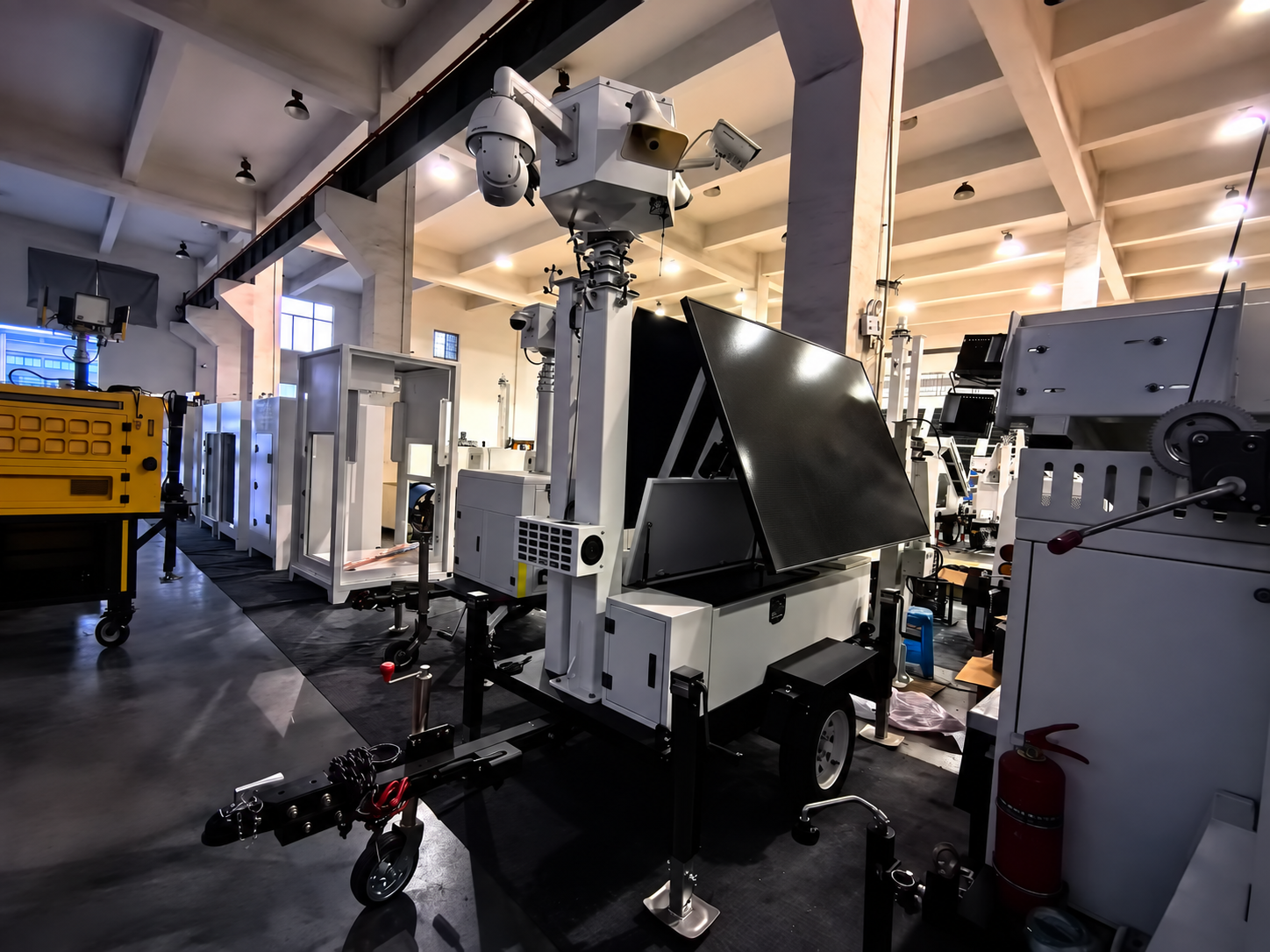
A solar mobile surveillance trailer is a towable, self-contained platform that supports cameras, communications equipment and other monitoring devices where permanent power and fixed infrastructure may be unavailable or impractical.
Choosing the right system requires more than comparing solar-panel size or mast height. Buyers must define what needs to be observed, how data will be transmitted, how much energy the equipment consumes and how the trailer will be deployed.
1. Start With the Monitoring Objective
The first question is not “Which trailer model should I buy?” It is “What must the system monitor?” A construction site may need to observe entrances, material-storage areas and equipment zones. A mining or road project may require visibility across a large temporary work area.
Before discussing equipment, describe the site type, monitored area, important entrances or assets, required observation distance, daytime and night-time requirements and how often the trailer will be moved. This information helps the supplier position the cameras, select a suitable mast and estimate the system load.
2. Define Camera Quantity and Type
Mobile surveillance trailers can support different camera arrangements, including dome and bullet camera options. The appropriate number and type depend on the project.
A wide area may need several viewing directions, while a gate or narrow access road may need a more focused view. Night-time performance, image detail and mounting position also affect the decision.
The quotation should clearly identify whether cameras are included, optional or supplied by the customer. It should list proposed camera models, mounting positions and compatibility with the recording and communications equipment. A trailer platform alone should not be assumed to include a complete monitoring service.
3. Confirm Connectivity and Remote Access
Remote viewing requires a suitable communications path. The S973 platform can be configured for 4G connectivity where network service is available, but coverage must be checked at the actual deployment location.
Before ordering, confirm mobile-network coverage, SIM card and data-plan responsibility, router and antenna requirements, remote user access, recording method, storage period, software, licences and recurring charges.
If the site has weak or no cellular coverage, the project may need an alternative communication method. This should be resolved before manufacture rather than after delivery.
4. Calculate the Complete Electrical Load
Solar panels and batteries must support the entire electrical system—not only the cameras. The load may include a recorder, router, antenna, controller, sensors, loudspeaker, auxiliary lighting or other project-specific devices.
Provide the power consumption and operating schedule of every device. The supplier also needs the destination, seasonal sunlight, possible shading and desired reserve period.
The S973 platform can be configured with solar panels and gel or lithium battery options. Final autonomy and charging performance depend on the selected configuration, local solar resource, equipment load and operating schedule. Buyers should therefore avoid relying on one universal runtime claim.
5. Select a Suitable Mast and Lifting Method
Mast height influences viewing angle and potential coverage, but a taller mast is not automatically the best choice. Camera capability, site layout, wind exposure, transportation and operating procedure must be considered together.
The S973 supports configurable mast heights from 4 to 9 metres, with manual, electric or hydraulic lifting options. A manual system can suit projects that value simplicity. Electric or hydraulic lifting can be useful when equipment is deployed frequently or operating convenience is a priority.
The selected mast, camera head and trailer structure should be treated as one complete configuration.
6. Review Trailer Stability and Site Setup
A mobile platform must be transported to the site and then deployed on suitable ground. The S973 uses a towable single-axle chassis and four outriggers to support setup.
Before ordering, confirm towing requirements, operating and transport dimensions, ground conditions, available setup area, outrigger arrangement, forklift or crane loading needs, relocation frequency and local wind conditions.
Operators should follow the supplied setup instructions and verify that the trailer is level and stabilised before raising the mast.
7. Check the Exact Supply Scope
Two surveillance trailers that look similar can include very different equipment. A useful quotation should separate standard equipment, optional equipment, customer-supplied items and recurring services.
Ask the supplier to specify the trailer, mast and lifting system; solar array and battery type; cameras and mounting hardware; recorder and storage; router and antenna; control system and electrical protection; software and licences; packaging, manuals and spare parts; and installation or support responsibilities.
This avoids misunderstandings about which party supplies the cameras, network service or monitoring software.
8. Plan Delivery and Commissioning
Remote-site equipment often travels long distances before installation. Buyers should review packing, unloading and assembly requirements in advance.
Confirm whether any parts are removed for transport, what lifting equipment is needed at the destination and which documents are supplied. The project team should also know who will configure user access and test the complete monitoring system.
Information to Send With Your Enquiry
- Quantity and destination country or city
- Site type and monitoring objective
- Site layout or required observation distance
- Camera equipment already available, if any
- Network coverage at the site
- Daily operating schedule
- Required battery reserve
- Mast height or viewing requirements
- Expected relocation frequency
- Required delivery date
The more complete the project information, the easier it is to compare proposals and avoid unnecessary equipment.
Configure the Trailer Around the Site
A reliable solar mobile surveillance trailer is a project configuration rather than a single fixed component list. Camera coverage, communications, power reserve, mast selection and deployment logistics must work together.
LUMTA’s S973 is a towable solar monitoring platform that can be configured for construction sites, mines, roads, farms, events and other remote locations. Review the S973 solar mobile surveillance trailer and our security and remote monitoring solutions.
Contact LUMTA with your site layout, destination, camera requirements, network conditions and operating schedule to discuss configuration options and request a quotation.