
How bright does a work site need to be at night? The answer is set by safety standards, and it depends on the task: walking around a site needs far less light than fixing reinforcement or installing electrical equipment. This guide lists the recommended light levels for construction, roadwork and mining tasks, explains lux and foot-candles, and includes a calculator to estimate how many light towers you need.
Quick answer: minimum lux levels for construction sites
- OSHA 29 CFR 1926.56 (US): at least 5 foot-candles (about 54 lx) for general construction area lighting, and 3 fc (about 32 lx) for concrete placement, excavation, waste and access areas.
- EN 12464-2 (Europe): 20 lx for clearance, excavation and loading; 50 lx for general construction areas; 100 lx for framework and reinforcement; 200 lx for demanding electrical, machine and pipe work.
Planning night work? Send us your site size and the lux level in your specification. LUMTA builds diesel and solar light towers in our own factories in Shandong and Zhejiang, China, with MOQ 1 unit, and we will suggest the number and type of towers with the quote.
Lux vs foot-candles vs lumens: quick answer
- Lux (lx) and foot-candles (fc) both measure illuminance: how much light lands on a surface. Lux is per square metre, foot-candles per square foot.
- 1 fc = 10.76 lx; 1 lx = 0.093 fc.
- Lumens (lm) measure the total light a lamp gives out. A light tower with 208,000 lm spread over 4,000 m² gives about 20 lx on average after losses.
| Foot-candles | Lux | Typical use |
|---|---|---|
| 3 fc | 32 lx | Excavation, access ways, storage areas (OSHA 1926.56) |
| 5 fc | 54 lx | General construction area lighting |
| 10 fc | 108 lx | General construction plant and shops |
| 30 fc | 323 lx | First aid stations and offices |
Not sure how many towers your site needs? Use the calculator below or ask us on WhatsApp.
Lux and foot-candles
Lux (lx) is the amount of light falling on a surface: one lumen per square metre. Foot-candles (fc) are the US unit: one lumen per square foot. 1 fc ≈ 10.76 lx. A full moon gives well under 1 lx; a typical office is lit to around 500 lx.
A lux figure on its own means little without the area. When a supplier says a light tower “covers 3,000 m²”, ask at what average lux.
Light towers that reach these lux levels
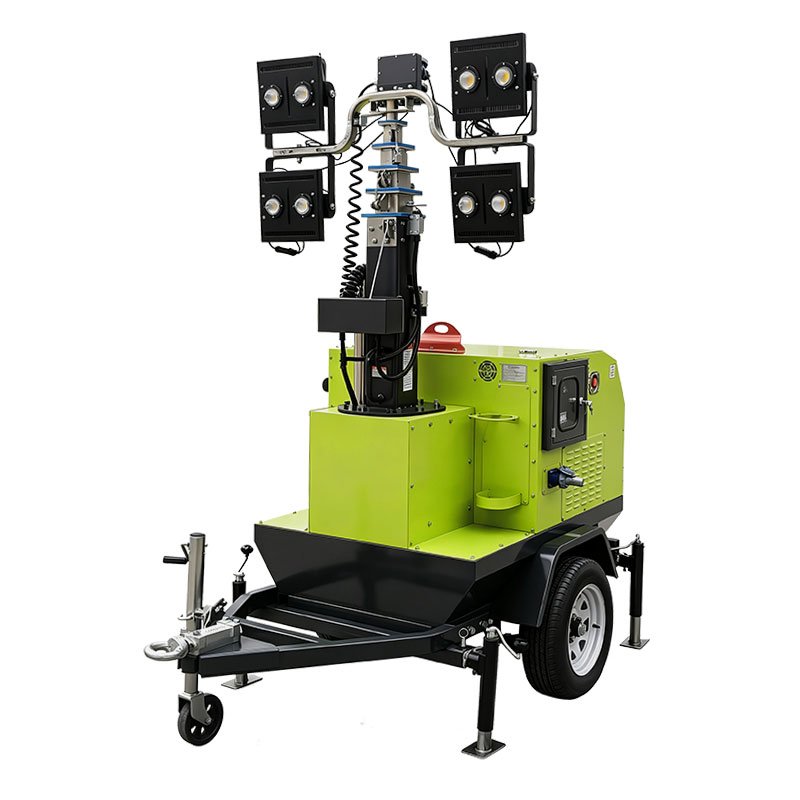 4LT1600M9Z482Kubota diesel9 m electric mast, 4 × 400 W LED, up to 68 h on 110 L. Rental fleet pick.View specs & quote →
 4LT600M9AH1200Solar1,410 W solar, 6 × 200 Ah gel batteries, 9 m mast, up to 20 h with zero fuel.View specs & quote →E4LT600M9AH1200Solar-diesel hybridSolar + gel battery + 3 kW diesel backup, up to 28 h on diesel.View specs & quote →
Recommended light levels: EN 12464-2
The European standard EN 12464-2, Lighting of work places – Part 2: Outdoor work places, gives maintained average illuminance for construction sites:
| Construction site task (EN 12464-2) | Average illuminance |
|---|---|
| Clearance, excavation and loading | 20 lx |
| Construction areas, drain pipe mounting, transport, auxiliary and storage tasks | 50 lx |
| Framework element mounting, light reinforcement work, wooden mould and framework mounting, electric piping and cabling | 100 lx |
| Element jointing, demanding electrical, machine and pipe mountings | 200 lx |
The standard also covers other outdoor work places such as railways, ports, petrochemical plants and car parks. Check the latest edition for your sector.
Minimum light levels: OSHA 29 CFR 1926.56
In the United States, OSHA 29 CFR 1926.56 sets minimum illumination for construction work while it is in progress:
| Area or operation (OSHA 1926.56, Table D-3) | Foot-candles | ≈ Lux |
|---|---|---|
| General construction area lighting | 5 fc | 54 lx |
| General construction areas, concrete placement, excavation and waste areas, access ways, active storage areas, loading platforms, refuelling and field maintenance areas | 3 fc | 32 lx |
| Indoors: warehouses, corridors, hallways and exitways | 5 fc | 54 lx |
| Tunnels, shafts and general underground work areas (10 fc during drilling, mucking and scaling) | 5 fc | 54 lx |
| General construction plant and shops | 10 fc | 108 lx |
| First aid stations, infirmaries and offices | 30 fc | 323 lx |
These are minimums. Many contracts and national standards ask for more, so check your project specification first.
How much area does one light tower cover?
Coverage depends on the lamp output, mast height, how the lamps are aimed and the light level you need. A practical rule of thumb: usable area (m²) ≈ total lumens × 0.4 ÷ target lux. For example, a 4LT1600M9Z482 with 208,000 lm covers roughly 4,000 m² at 20 lx, or about 1,700 m² at 50 lx. This is an estimate, not a measured layout; for a real site, ask us for a lighting layout.
Higher-output towers cover more ground at the same level. Our diesel towers, such as the 4LT1600M9Z482 with 4 × 400 W LED, give much more light than a 400 W solar tower. Ask us for a layout for the tower you are considering.
High-output LED lamp heads: DIALux simulation
For sites that need more light, we can fit high-output LED lamp heads on request: about 55,500 lm per 300 W lamp or about 74,000 lm per 400 W lamp. We modelled one tower with four of these lamps in DIALux over a 105 × 68 m area (about 7,140 m², the size of a football pitch), with a maintenance factor of 0.8.
| Lamp heads | Total output | Mast height | Average | Maximum | Minimum |
|---|---|---|---|---|---|
| 4 × 300 W LED | ≈ 222,000 lm | 7 m | 12 lx | 165 lx | 0.84 lx |
| 4 × 400 W LED | ≈ 296,000 lm | 9 m | 16 lx | 152 lx | 1.43 lx |


The averages are low because one tower is spread over a whole pitch. Light is concentrated near the tower, above 100 lx, and falls to under 2 lx at the far corners. To light a large area evenly, use several towers. These are software simulations, not site measurements; confirm the lamp heads and mast height in your quotation.
Recommended light towers for these light levels
- 4LT1600M9Z482: 208,000 lm on a 9 m electric mast, up to 68 h per tank. About 4,000 m² at 20 lx.
- LFNVP4000: 440,000 lm on a 9 m hydraulic mast, for mines and quarries that need the most light per tower.
- 4LT600M9AH1200: solar, zero fuel, up to 20 h of light, for quiet and urban sites.
How many light towers do I need?
A rough estimate: usable area ≈ tower lumens × 0.4 ÷ target lux. The 0.4 factor allows for light that falls outside the work area and for losses. Ask us for a lighting layout for an exact number.
The result is an estimate of the number of towers, not a lighting design. On a site with no mains supply the power source decides the running cost: a hybrid light tower such as the E4LT600M9AH1200 runs on solar and battery first (up to 20 h) and falls back to its 3 kW diesel generator. Where there is no fuel supply at all, a 4LT600M9AH1200 solar light tower removes refuelling entirely.
Recommended light towers by light level
Use the light level in your specification to pick a starting diesel or solar model. The figures are from our product catalogues; we confirm the lamp heads, mast and number of towers against your site layout in the quotation.
| Model | Best for | Key specification | Quote |
|---|---|---|---|
| 4LT600M9AH1200 solar light tower | Solar · 20–32 lx: access ways, excavation, storage and loading areas, with no fuel on site | 4 × 150 W Plusrite LED (84,000 lm), 9 m mast, 3 × 470 W solar panels, 6 × 200 Ah battery bank; up to 20 h of lighting | Quote 4LT600M9AH1200 |
| WK1600M5 walk-behind light tower | Walk-behind · small or tight sites where a trailer cannot go; pushed by hand | 4 × 400 W LED, 4.8 m hand-crank mast, 2.8 kVA generator, 25 L tank; up to 13 h | Quote WK1600M5 |
| 4LT1600M7BATFC diesel light tower | Diesel · 50 lx general construction areas and roadwork | 4 × 400 W LED, 7 m hand-winch mast, BAT air-cooled diesel; up to 25 h; 72 dB(A) at 7 m | Quote 4LT1600M7BATFC |
| 4LT1600M9BAT8KW light tower generator | Diesel · 50–100 lx sites that also need power for tools | 4 × 400 W LED (160,000 lm), 9 m hand-winch mast, 8 kW generator; about 13 h on 16 L; runs on mains too | Quote 4LT1600M9BAT8KW |
| 4LT1600M9Z482 diesel light tower | Diesel · 100–200 lx framework, reinforcement and installation work on long shifts | 4 × 400 W LED (208,000 lm), 9 m electric mast, Kubota Z482 engine, 110 L tank; up to 68 h | Quote 4LT1600M9Z482 |
| 4LT1600M9CC6.5KW diesel light tower | Diesel · mining, quarries and multi-day work without refuelling | 4 × 400 W LED (208,000 lm), 9 m mast with 360° rotation, Changchai water-cooled engine, 110 L tank; up to 68 h | Quote 4LT1600M9CC6.5KW |
Not sure which one fits? Compare all diesel light towers and solar light towers, or send us your site sketch.
Get a quote for your site. Tell us the area, the tasks, the hours per night and whether you have fuel or mains on site. We reply with recommended models, quantity and an FOB or CIF price.
Need a lighting plan for your site? Send your site size and quantity, and we reply with a lighting plan and an FOB or CIF price within 24 hours.
Tips for lighting a site evenly
- Raise the mast fully. A higher mast spreads light over a wider area and reduces glare.
- Aim down, not out. Tilt the lamps towards the work area and away from roads and neighbours.
- Overlap the pools of light. Several towers placed around a site give more even light and fewer shadows than one bright tower.
- Light the task, not the whole site. Put more light where people work and less on access routes and storage.
- Check with a meter. A simple lux meter at ground level tells you whether the site meets the standard.
Light level FAQ
How many lux do you need on a construction site?
EN 12464-2 recommends 20 lx for clearance, excavation and loading, 50 lx for general construction areas, transport, storage and auxiliary tasks, 100 lx for framework and reinforcement work, and 200 lx for demanding electrical, machine and pipe installation. In the US, OSHA 29 CFR 1926.56 sets minimums in foot-candles: 5 fc (about 54 lx) for general construction area lighting and 3 fc (about 32 lx) for excavation, waste and access areas.
How do I convert foot-candles to lux?
1 foot-candle is about 10.76 lux. Multiply foot-candles by 10.76 to get lux, or divide lux by 10.76 to get foot-candles.
How much area does one light tower light?
It depends on the lamps, mast height, aim and the light level you need. As a rule of thumb, usable area ≈ total lumens × 0.4 ÷ target lux: a 4LT1600M9Z482 with 208,000 lm covers roughly 4,000 m² at 20 lx. The higher the light level you need, the smaller the area one tower can cover.
Is the calculator result exact?
No. It is a rough estimate that assumes light spreads evenly and scales with area. Mast height, aiming, obstacles and the shape of the site all change the result. Use it to start a conversation, then ask for a lighting layout.
Get a lighting layout and quote
Send a site sketch with dimensions, the tasks and the light level in your specification. We will suggest the number and type of towers.
See also: mobile light towers · light towers for construction and roadworks · light towers for mining and quarries · LED vs metal halide light towers
Light your site to the right lux level
Tell us the work area, target lux and operating hours and we will size the towers for you. MOQ 1 unit · production 45–60 days · FOB or CIF quote within 24 hours.
Get a factory quoteWhatsApp usOnce you know the lux levels your site needs, the next step is choosing the hardware — browse LUMTA portable light towers for sale, each listed with photometric data.
Get a free lighting plan for your site
Tell us the work area size (or a site photo), the lux level you need and the nightly hours. Our engineers reply within 24 hours with how many light towers you need, the recommended model and an FOB or CIF price.