Many copper, gold and lithium mines in Chile, Peru, Bolivia and Argentina sit between 3,000 and 4,500 metres above sea level, and some Mexican sites are high too. A light tower that runs perfectly at a coastal port can struggle there: the engine smokes black, loses power and the lamps flicker when the generator can no longer carry the load. This guide explains why that happens and how to choose a light tower that will run all night at altitude.
Quick answer: choosing a light tower for a high-altitude site
- Above about 3,000 m, a standard diesel engine is not enough. Thin air means incomplete combustion, black smoke and lost power.
- Specify a high-altitude engine (turbocharged or factory-calibrated for altitude) matched to your site’s elevation. A three-cylinder engine is a better choice than a single-cylinder engine for this duty.
- Leave a power margin. Size the generator so the lamps and any auxiliary loads still fit after altitude derating.
- Solar and battery light towers are not affected by thin air, but cold and winter sun still have to be designed for.
- Tell the supplier your altitude, temperature range and current equipment before they quote.
Lighting a mine above 3,000 m? Send us the site altitude and temperature range. We build diesel and solar light towers in our own factory and configure a high-altitude engine to suit your site.
Why diesel light towers struggle above 3,000 m
A diesel engine needs a fixed amount of oxygen to burn each injection of fuel. As you climb, air pressure and density fall, so every intake stroke pulls in less oxygen. A standard engine keeps injecting the fuel it was set up for at sea level, and there is no longer enough air to burn it all.
The results are easy to see on site:
- Black smoke. This is unburned fuel. Our factory engineers see it on standard engines once they go above roughly 3,000 m. Black smoke means incomplete combustion, and it brings carbon build-up, fouled injectors and diluted engine oil if the engine keeps running that way.
- Lost power. Less oxygen means less energy from each stroke. The generator can no longer deliver its rated output, so lamps dim, flicker or trip when the mast motor or another load starts.
- Higher fuel use per kWh and more heat. The engine works harder for the same light, and thin air also cools the engine and alternator less effectively.
- Hard cold starts. High Andean sites are often below freezing at night, and cold plus low oxygen makes starting harder.
How thin is the air?
The table uses the International Standard Atmosphere. The power column is an indicative rule of thumb for a naturally aspirated diesel (about 1% loss per 100 m above 1,000 m). Real derating depends on the engine and temperature, so always check the engine maker’s derating curve for the exact model.
| Altitude | Air density vs sea level | Indicative power left (naturally aspirated) |
|---|---|---|
| 1,000 m | about 91% | about 100% (typical rating altitude) |
| 2,000 m | about 82% | about 90% |
| 3,000 m | about 74% | about 80% |
| 3,500 m | about 71% | about 75% |
| 4,000 m | about 67% | about 70% |
| 4,500 m | about 63% | about 65% |
At a 4,000 m pit, a standard engine may have lost close to a third of its power. A generator that was comfortably sized at sea level can end up running flat out, or past its limit, just to keep the lamps on.
How to choose a light tower for a high-altitude mine
1. Specify a high-altitude engine, not a standard one
The main fix is the engine. There are two common routes:
- Turbocharged engines compress intake air before it enters the cylinders, so they hold their power much better as the air thins. They still have an altitude limit, so check the rating for your elevation.
- Engines calibrated for altitude adjust fuel delivery to the air actually available, which stops the black smoke and protects the engine.
Our standard light tower engines are built for normal conditions. For sites above 3,000 m we configure a suitable high-altitude engine for the order, matched to the altitude you give us, and confirm the engine model in the quotation.
2. Prefer a three-cylinder engine over a single-cylinder
Single-cylinder diesels are compact and simple, and they work well on many low-altitude jobs. At altitude, a three-cylinder engine is the better choice: it has more displacement to absorb the power loss, runs more smoothly under continuous load, and gives the generator a steadier output, which means steadier light. Lower vibration is also kinder to the mast, lamp brackets and wiring over a long contract.
3. Leave a power margin after derating
Add up the loads that run together: the LED lamps, the mast winch or motor if it runs while lamps are on, and any extra devices such as cameras, pumps or a site office socket. Then size the generator so that this total still fits inside the power that is left at your altitude, not the sea-level nameplate rating. Our diesel light tower generator sizing guide walks through the load calculation.
4. Plan for cold as well as thin air
Most high-altitude sites are also cold. Ask about low-temperature starting aids, the coolant and engine oil grade, winter-grade diesel and battery capacity for cold cranking. Night temperatures, not daytime ones, decide whether the tower starts at shift change.
5. Consider solar or battery towers for light-duty areas
Solar panels, batteries and LED lamps do not need oxygen, so a solar light tower gives the same output at 4,000 m as at sea level. Sunlight at altitude is also strong. They suit gates, parking areas, camps, walkways and lighter-load areas where nightly energy needs are moderate. Two cautions: battery capacity drops in the cold, and lithium batteries must not be charged below freezing unless they have heating or a suitable battery management system, so the system has to be sized for winter nights. For the main pit and heavy loads, a high-altitude diesel tower is usually the more practical choice.
6. Check the rest of the build
- Wind: high plateaus can be very windy. Check the wind rating of the mast and use the outriggers. See our mast height and wind stability guide.
- Dust: open pits are dusty, so ask for heavy-duty air filtration and plan more frequent filter checks.
- UV: UV is much stronger at altitude, so paint, cables and seals should be UV resistant.
- Fuel tank: remote pits mean long refuelling runs, so a larger tank reduces trips. See our mining light towers for typical tank sizes and runtimes.
Diesel or solar at altitude: a quick comparison
| Standard diesel | High-altitude diesel | Solar / battery | |
|---|---|---|---|
| Above 3,000 m | Black smoke, power loss | Engine configured for the site altitude | Not affected by thin air |
| Heavy or extra loads | Reduced capacity | Yes, with a sized margin | Limited by battery size |
| Cold nights | Hard starting | Needs cold-start package | Battery capacity drops; size for winter |
| Fuel logistics | Refuelling runs | Refuelling runs | No fuel |
| Best fit | Sites below about 3,000 m | Main pit, haul roads, heavy loads | Gates, camps, parking, light-duty areas |
What to tell us before we quote
The right engine depends on the site, so please include these details in your enquiry:
- Site altitude in metres, or the highest point where the towers will work.
- Temperature range: the coldest night and the hottest day.
- What you use now: the engine and light tower model on site today, and any problems such as black smoke, power loss or hard starting.
- Loads: number of lamps and any extra equipment the tower must power.
- Running hours per night and how often you can refuel.
- Quantity, destination and any mine-site acceptance requirements.
With this information we confirm the engine, generator size and options in the quotation, so you are comparing a configuration built for your altitude, not a sea-level machine.
Field example: a diesel light tower at a winter mine site in Inner Mongolia
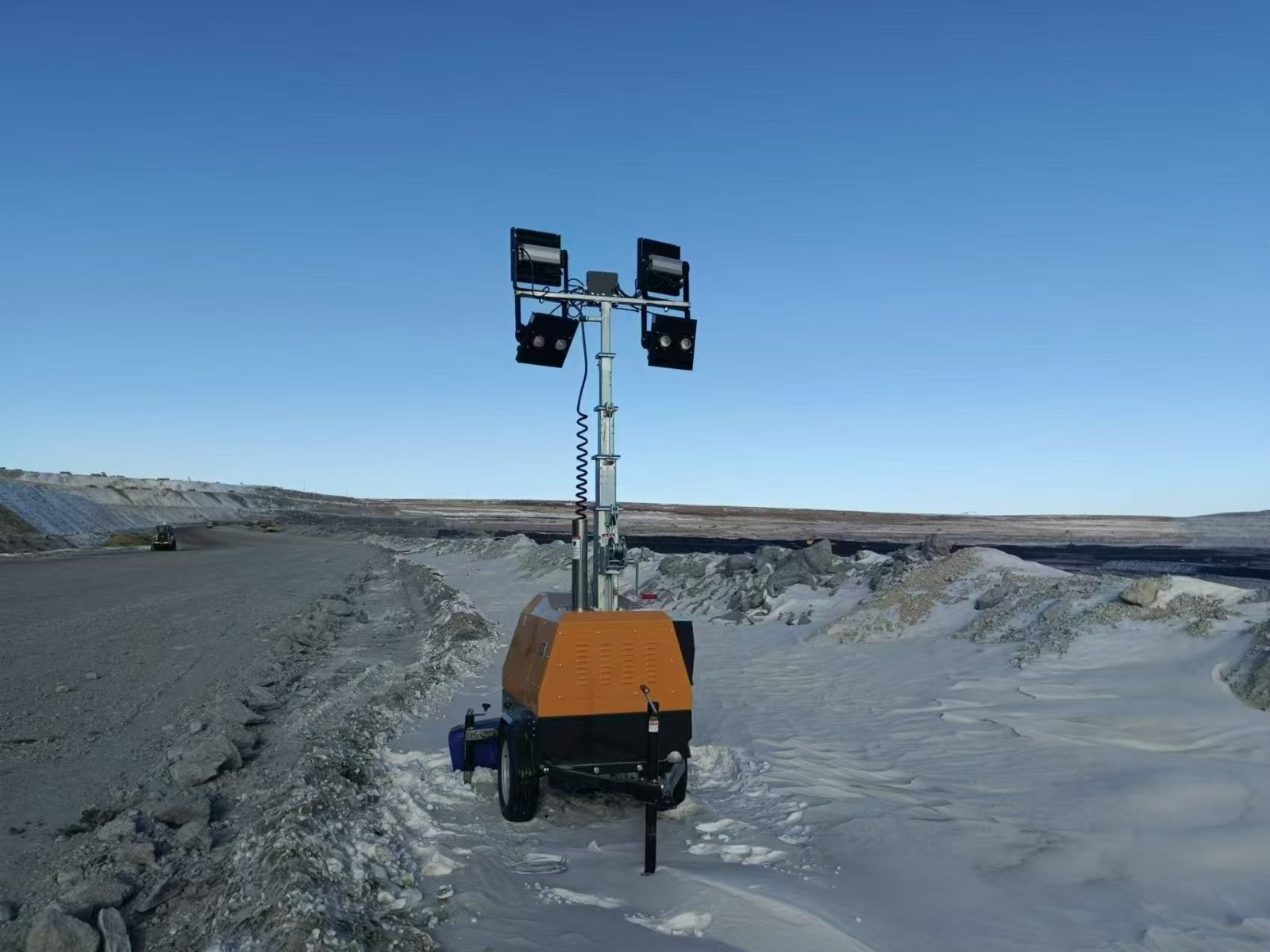
These photos come from a mine site in Inner Mongolia, China, where one of our trailer-mounted diesel light towers works through the winter. The unit has four LED floodlights on a telescopic mast and is fitted with a Kama single-cylinder diesel engine. It shows the conditions mine lighting has to deal with: snow, frozen ground, wind across open benches and long nights.
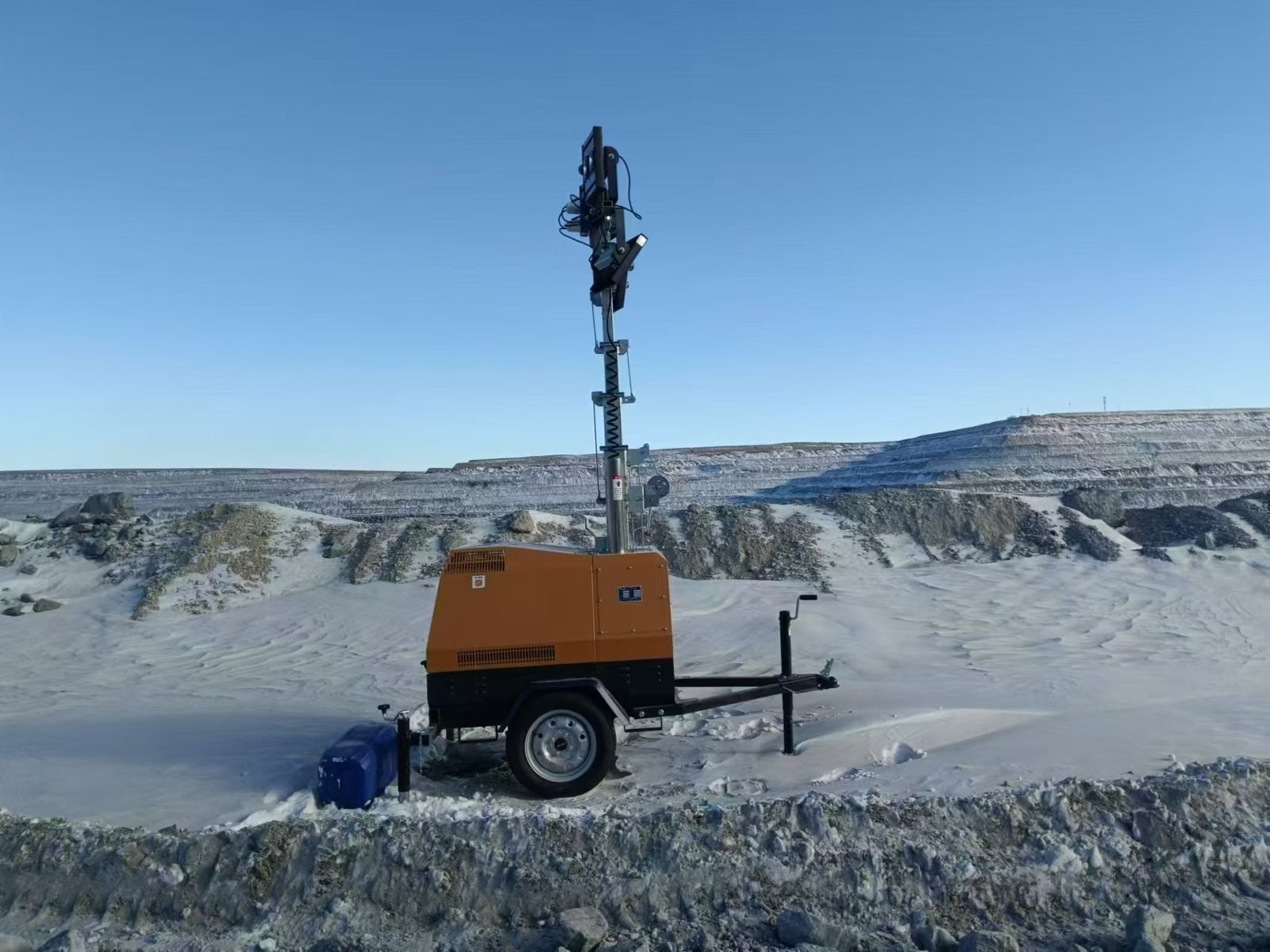
A single-cylinder engine is a sensible choice for a site like this. For a mine in the Andes at 3,500 or 4,000 m, we would not send the same configuration: we would quote a three-cylinder, high-altitude engine sized for the elevation and the night-time temperature.
FAQ
Can a diesel light tower work at high altitude?
Yes, if the engine is chosen for the altitude. A standard diesel engine above about 3,000 m tends to smoke black and lose power because there is not enough oxygen to burn the fuel. A turbocharged or altitude-calibrated engine, with the generator sized for the derated output, will run reliably.
Why does a light tower engine produce black smoke at high altitude?
Black smoke is unburned fuel. At altitude the thin air does not supply enough oxygen for the fuel a standard engine injects, so combustion is incomplete. Left uncorrected, it causes carbon build-up, fouled injectors and lost power.
How much power does a diesel engine lose at altitude?
A common rule of thumb for naturally aspirated diesel engines is about 1% of rated power for every 100 m above 1,000 m, so roughly 20% at 3,000 m and 30% at 4,000 m. Turbocharged engines lose less. Always check the derating curve for the specific engine.
Is a single-cylinder or three-cylinder engine better for a high-altitude light tower?
A three-cylinder engine is the better choice for high-altitude duty. It has more power to absorb altitude losses, runs more smoothly under continuous load and gives steadier generator output. Single-cylinder engines suit lighter jobs at lower altitudes.
Are solar light towers a good option for high-altitude mines?
Solar light towers are not affected by thin air and benefit from strong sunlight at altitude, so they suit gates, camps, parking and other light-duty areas. Batteries lose capacity in the cold and lithium batteries need protection from charging below freezing, so the system must be sized for winter nights. Heavy loads in the main pit are usually better served by a high-altitude diesel tower.
Can LUMTA supply a light tower for a mine at 4,000 m?
Our standard engines are not intended for sites above about 3,000 m. For high-altitude orders we configure a suitable high-altitude engine to match the site. Send us the altitude, temperature range and the equipment you use now, and we will confirm the engine and configuration in the quotation.
Get a light tower configured for your altitude
Tell us your site altitude, temperature range and current equipment. We will propose an engine, generator size and lighting layout for your mine.

Scan to WhatsApp Kate
See also: diesel light towers for mining sites · diesel mobile light towers · generator sizing and best load · lux levels for mining and construction