
Plan mobile light tower transport around the exact unit, the route and the receiving site. Confirm whether it will be towed or carried on a truck, obtain its transport weight and dimensions, and use its own manual for stowing and loading. Wheels and a drawbar are not enough to establish road suitability.
Compare mobile light towers by the folded dimensions, weight basis and transport arrangement of the actual quoted unit. If mast height drives the choice, check how each telescopic light tower stows its mast for travel.
For road towing, start with the towing vehicle and trailer limits. The DVSA trailer safety checklist requires checking the vehicle’s towing capacity and the trailer’s permitted weight. Its legal guidance applies to Great Britain; confirm the rules for your destination separately.
Choose the transport route before choosing the configuration

Workshop configuration, not a transport-ready unit. This photo identifies components to discuss with the supplier; it does not demonstrate road approval.
| Your situation | Route to evaluate | What to confirm first | Main trade-off |
|---|---|---|---|
| Moving within a controlled site | Site movement following the unit’s manual | Ground condition, stowed mast, clear route and suitable moving equipment | A short distance still needs a movement check; site use does not establish road legality. |
| Moving between sites by road | Towing, where the unit and vehicle are suitable | Destination requirements, weight ratings, hitch, brakes where required, lights and documents | Convenient for repeated moves, but eligibility depends on the complete combination. |
| Receiving equipment by truck | Carrier delivery | Transport dimensions, loaded weight, approved restraint points and unloading equipment | Useful when direct towing is unsuitable; loading and unloading need their own plan. |
| Planning an export shipment | Packed or containerized freight | Final packing layout, packed dimensions, shipment weight and receiving arrangements | Discuss packing before booking; do not estimate container capacity from a product photo. |
Buyer action: send the destination and intended route with your inquiry. Ask the supplier to confirm the transport configuration in writing before arranging the vehicle or carrier.
Compare portable light towers for sale or review diesel mobile light towers once those constraints are clear.
Shipping light towers to your country?
Tell us the model, quantity and destination port. We will confirm the packing, loading information and freight with the quotation.
Check the stowed unit, then check the towing connection

Coupling detail on the photographed unit. This image does not show a connection to a towing vehicle.

The support shown is deployed. Confirm the required travel position and locking procedure in the unit manual.
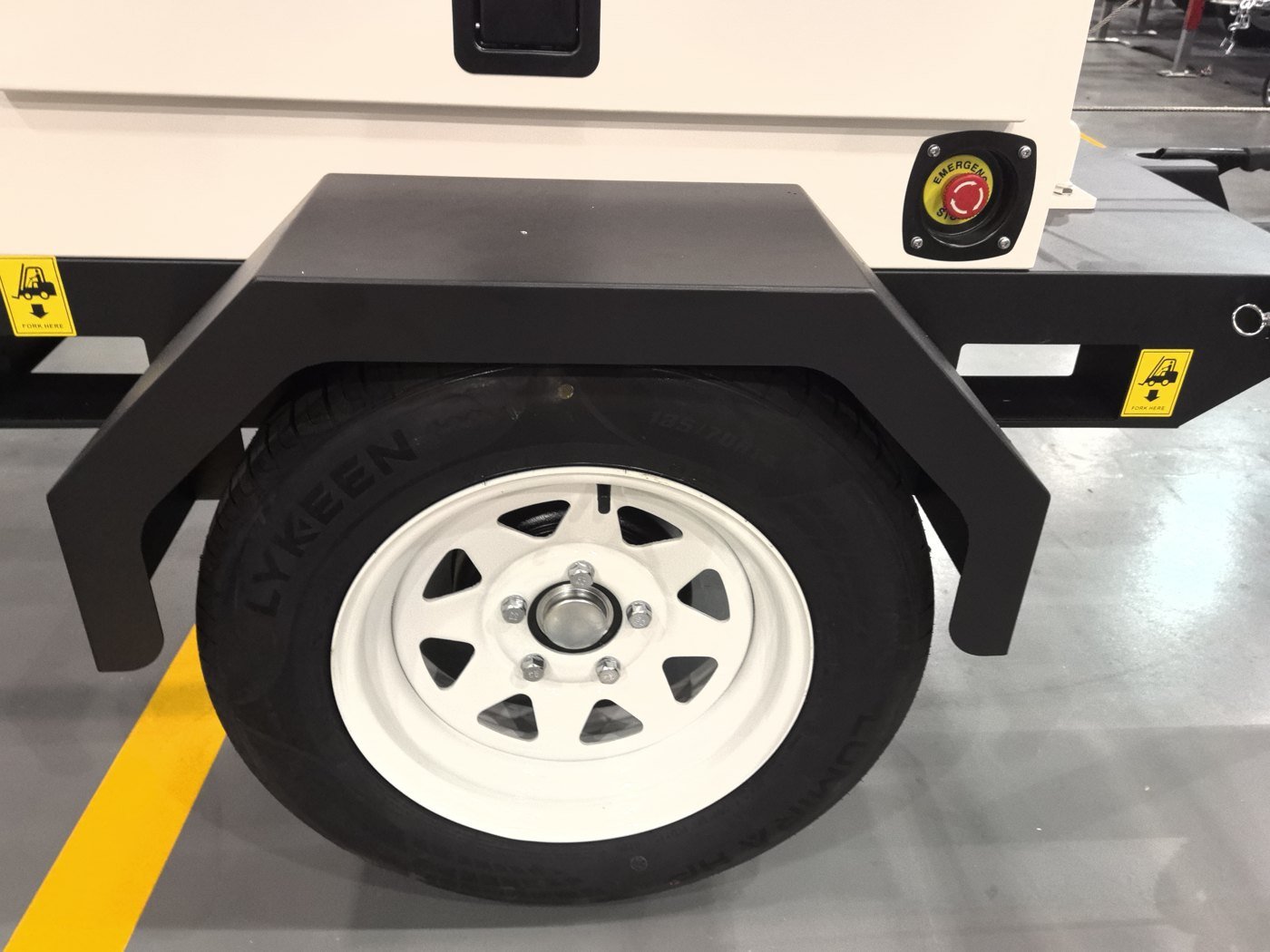

Inspect tires and wheel fasteners, and test the required road lights before dispatch.
A transport check starts with the machine, before the hitch. Ask LUMTA for the operating and transport instructions that match your selected model. Confirm the shutdown procedure, mast and light assembly travel positions, required locks, support positions and cover security before dispatch. Use the supplied instructions for the actual sequence.
Use this table as a dispatch record. Follow your unit’s manual for the actual sequence and locking positions.
| Check | Evidence to record | Pause dispatch when… |
|---|---|---|
| Engine, lights and controls | Shutdown completed using the model’s procedure | The procedure is unclear or a fault remains unresolved. |
| Mast and light assembly | Photo of the specified stowed position and required locks | The mast is raised, a required lock is missing, or the light assembly cannot be secured. |
| Stabilizers, jacks and covers | Photo of each specified travel position | A support or cover cannot be secured as instructed. |
| Tires and wheels | Inspection result and pressure/torque checks against the applicable specification | There is visible damage or the required specification is unknown. |
| Towing connection | Correct coupling, locking check and applicable safety-device connection | The coupling or connection is incompatible, damaged or uncertain. |
| Road lights and load | Working-light check and secured-load confirmation | Required lights fail, weight limits are unresolved or loose items remain. |
The DVSA checklist covers coupling, tires, wheel fasteners, lights and load security. It distinguishes breakaway cables from secondary couplings according to the trailer arrangement. Check which device your unit requires.
Record a pass or an unresolved issue for each row. A photograph supports the record but does not replace a functional check or the model-specific instructions. Resolve any uncertain required lock, specification or connection before moving the unit.
For a wider purchase acceptance check, use the pre-delivery inspection checklist.
Shipping light towers by sea: container loading
For export, towers ship in plywood crates or on pallets inside a container. How many fit is not a fixed number: it depends on the model, its size and how far it is disassembled. Typical examples from our loading records:
| Model type | Packing | 40 ft HC | 20 ft |
|---|---|---|---|
| 4LT1600M9Z482 9 m diesel (Kubota Z482) | Mast, wheels and drawbar removed; main crate 145 × 137 × 119 cm + mast crate 235 × 56 × 60 cm, double-stacked | 16 | ask us |
| 9 m diesel tower | Fully disassembled (mast, axle, drawbar packed separately) | up to 14 | ask us |
| 4LT600M9AH1200 solar tower | Wheels on, drawbar and mast removed; crate 2.35 × 1.75 × 2.5 m | 6 | 3 |
| 4LT1600M7BATFC compact 7 m | Mast removed | up to 26 | ask us |
- Accessories, lamps and outrigger legs travel boxed with each unit.
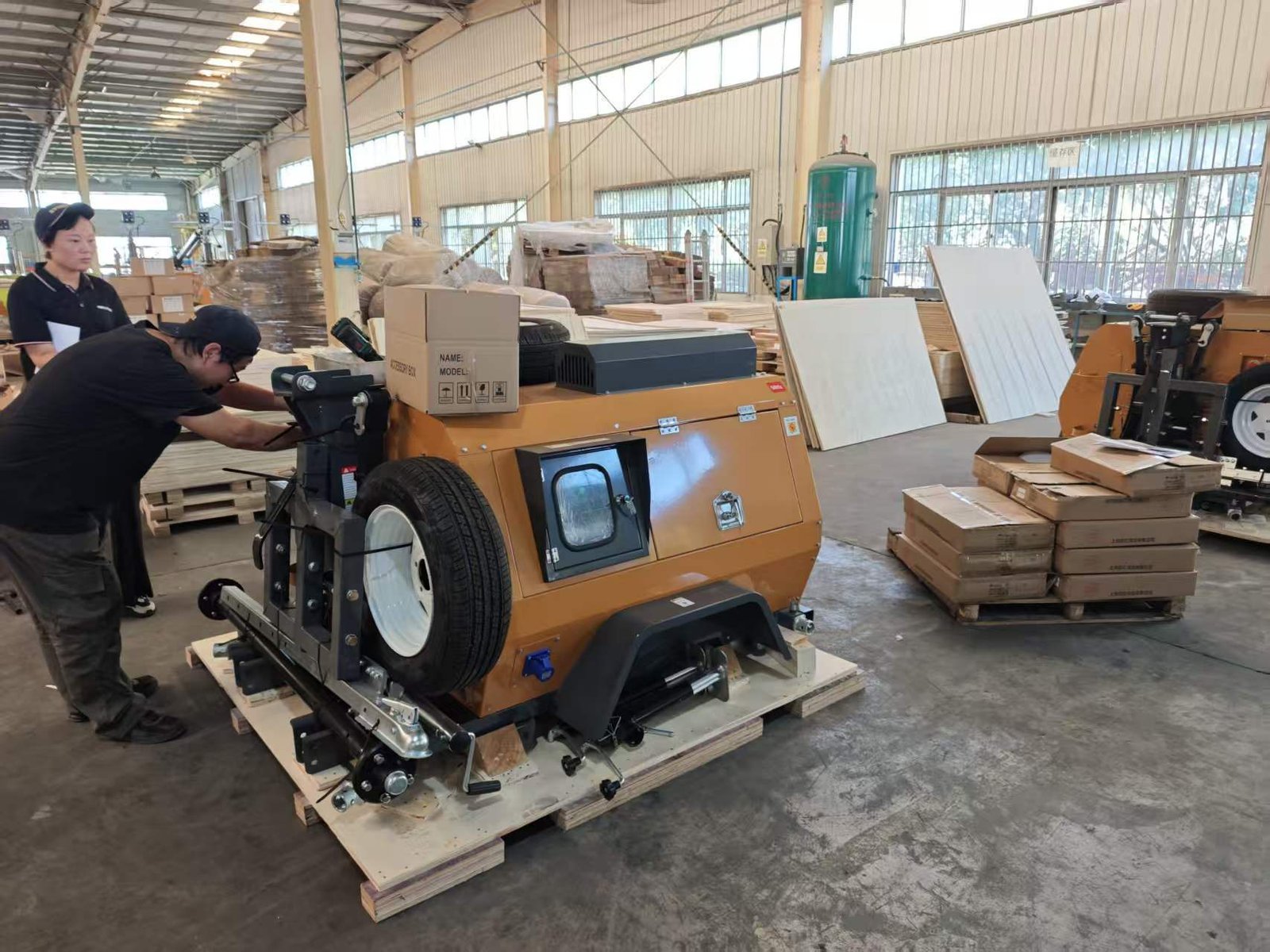
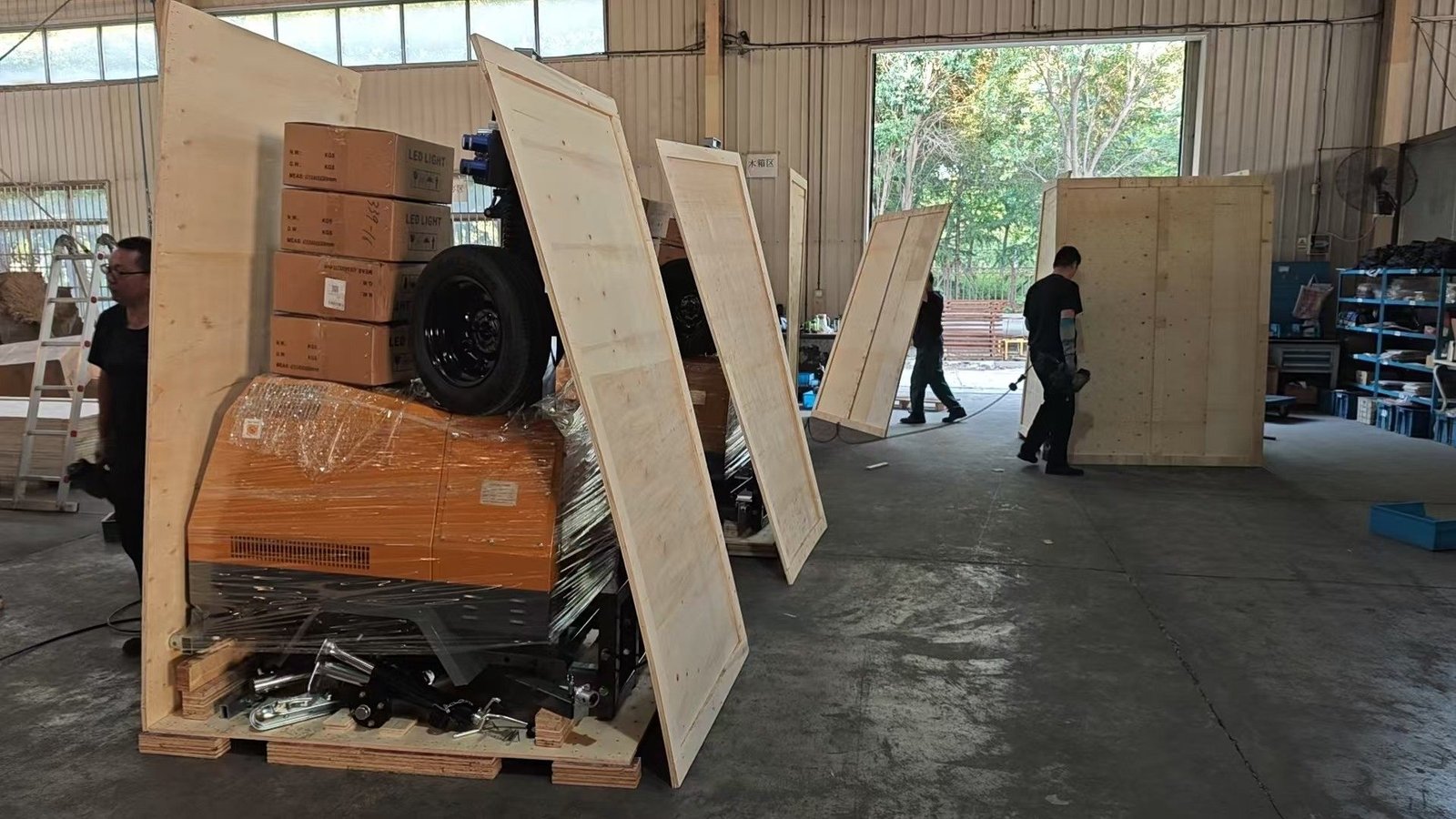
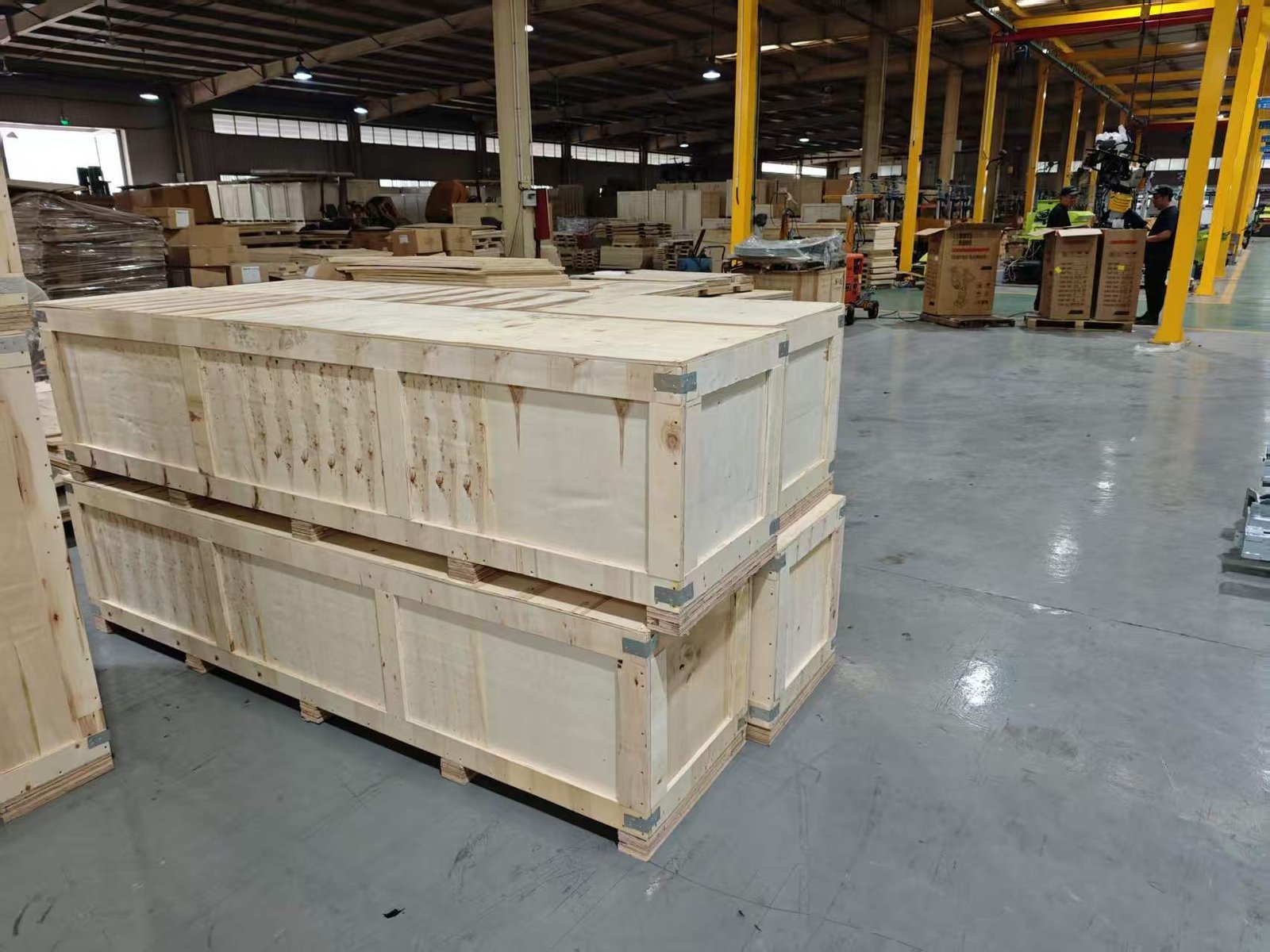
Ask us for the packing list and loading plan for your port with your quotation.
Truck loading: ask for the lifting and restraint diagram

A visible attachment lug does not establish its approved purpose or load rating. Ask for the matching lifting and restraint diagram before using it.
Before booking a truck, ask for the transport weight, stowed dimensions and approved loading instructions for the ordered configuration. Tell the supplier how the receiving site will unload it.
Ask LUMTA for both the loading instructions and the carrier restraint diagram for your selected configuration. Confirm the approved attachment points and handling requirements before arranging equipment; do not identify a lifting point from its shape alone.
- For lifting: request the approved lifting-point diagram, equipment requirements and handling procedure.
- For restraint: request the approved restraint points and load-securing instructions for the selected carrier arrangement.
- For receiving: confirm available equipment and access, then agree how the unit will leave the truck or container.
Use only the lifting and restraint points specified for your selected unit. If the supplied drawing does not match the equipment, request clarification before loading.
Information to send before the freight quotation
| Send to the supplier | Ask the supplier to confirm |
|---|---|
| Model and selected configuration | Transport dimensions and weight for that configuration |
| Destination and proposed transport route | Documents and configuration requirements to verify |
| Towing vehicle or carrier details | Compatibility checks and unresolved constraints |
| Unloading equipment at the receiving site | Suitable unloading procedure and attachment-point instructions |
| Whether accessories travel fitted or packed separately | Packing list, packed dimensions and handling details |
Keep the confirmed drawing and packing list with the dispatch record. At arrival, compare the delivered unit with those documents before unloading or preparing it for use.
Watch our workshop equipment demonstration
Our workshop footage shows the light tower and movement of its mast/light assembly. It does not show road towing, truck loading or a complete dispatch check. Use the supplied manual for the operating and transport procedure. The video is shown without audio.
Light Tower Transport FAQ
Can a mobile light tower be towed on public roads?
Only if the unit and towing vehicle meet the road rules of your country, including weight ratings, brakes where required, lights and registration. Wheels and a drawbar alone do not make a tower road-legal; confirm the transport configuration with the supplier.
How are light towers shipped for export?
Units are packed for container or flat-rack freight with the mast lowered and components secured. The final packing layout, packed dimensions and shipment weight are confirmed for the order before booking freight.
What size and weight is the LF6133 for shipping?
The LF6133 portable flood light ships in a wooden case of 155 × 50 × 80 cm, with 72 kg net and 95 kg gross weight.
How should a light tower be secured on a truck?
Use the approved lifting and restraint points for that model, with the mast lowered and locked. Ask the supplier for the lifting and restraint diagram before loading.
Planning an order or a site move?
Send the destination, intended transport route, chosen configuration and available unloading equipment with your inquiry. Ask for transport information alongside the equipment quotation, so the delivery plan and product selection can be checked together.
Discuss your light tower requirements or use the quotation information checklist.
Get a shipping and FOB/CIF quote
Send the model you need, quantity and destination port. We reply within 24 hours with the packing method, units per container and an FOB or CIF price. MOQ 1 unit.