
S973 Solar Mobile Surveillance Trailer
The S973 solar surveillance trailer is a mobile monitoring platform for projects that need camera coverage at temporary or remote sites. The confirmed 2026 selection catalogue describes one S973 configuration with four PTZ cameras, three 450 Wp bifacial panels and a 5.12 kWh LiFePO4 battery. Specify the camera models, recording, connectivity and power requirements for your site; these services and components must be confirmed in the written quotation. Compare it with other models in our solar surveillance trailer range.
Request S973 Configuration & PricingCompare S973 & S963
For a project quote, send the site location, camera requirements, network coverage, operating schedule and quantity. Camera supply, data plans and recurring services are confirmed separately in the quotation.
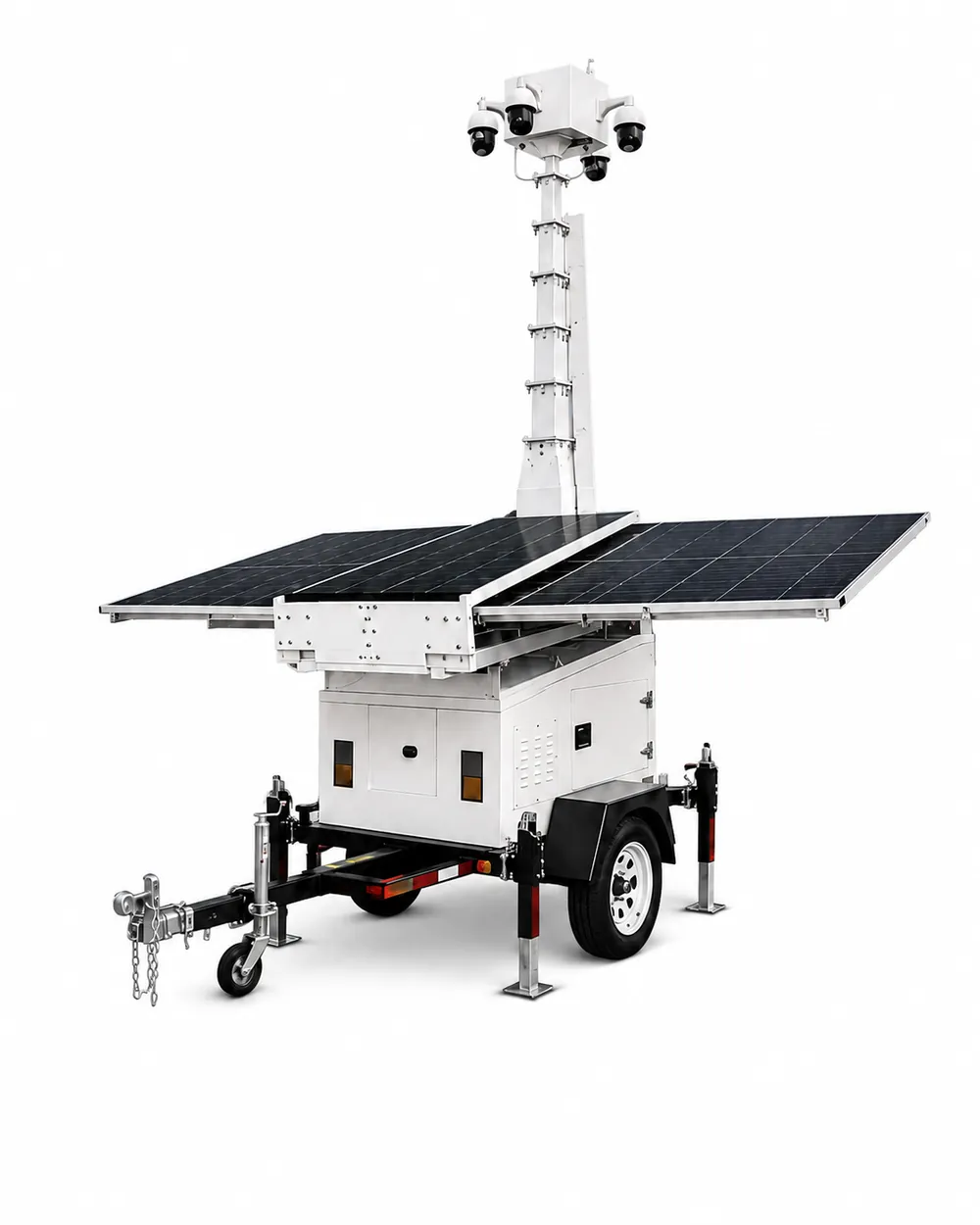
S973 configuration in the confirmed 2026 catalogue
These values describe the S973 surveillance configuration in the confirmed selection catalogue. A separate website-listed configuration has different solar, battery and camera options; do not mix the two versions.
| Item | 2026 catalogue configuration | Confirm for the order |
|---|---|---|
| Cameras | 4 × PTZ | Camera models, mounting, recording, observation task and night-time requirements |
| Solar array | 3 × 450 Wp bifacial panels; 1,350 Wp total | Panel model, mounting and site solar conditions |
| Battery | 5.12 kWh LiFePO4 with integrated BMS; 25.6 V / 200 Ah | Usable reserve and charge/discharge limits for the complete equipment load |
| Rated voltage | 24 / 48 VDC | Exact electrical interfaces and camera power requirements |
| Protection / weight | IP55 / 800 kg | Applicable equipment protection, towing and destination requirements |
| Operating temperature | −10°C to +50°C | Site conditions and operating limits for the quoted package |
| Folded / deployed dimensions | 2,100 × 1,450 × 2,350 / 2,650 × 2,450 × 7,000 mm (L × W × H) | Access, setup space, mast arrangement and transport method |
The separate website-listed reference describes three 380 W panels, four 200 Ah gel/lithium battery options and dome/bullet camera options. Those fields are not the catalogue configuration. The catalogue gives a deployed height dimension but does not specify the mast lifting mechanism or a monitoring-runtime figure.
Read the confirmed product selection catalogue and request the matching component schedule with your quote. Camera specifications, recording, connectivity and included accessories must be stated separately.
Solar surveillance trailer photos
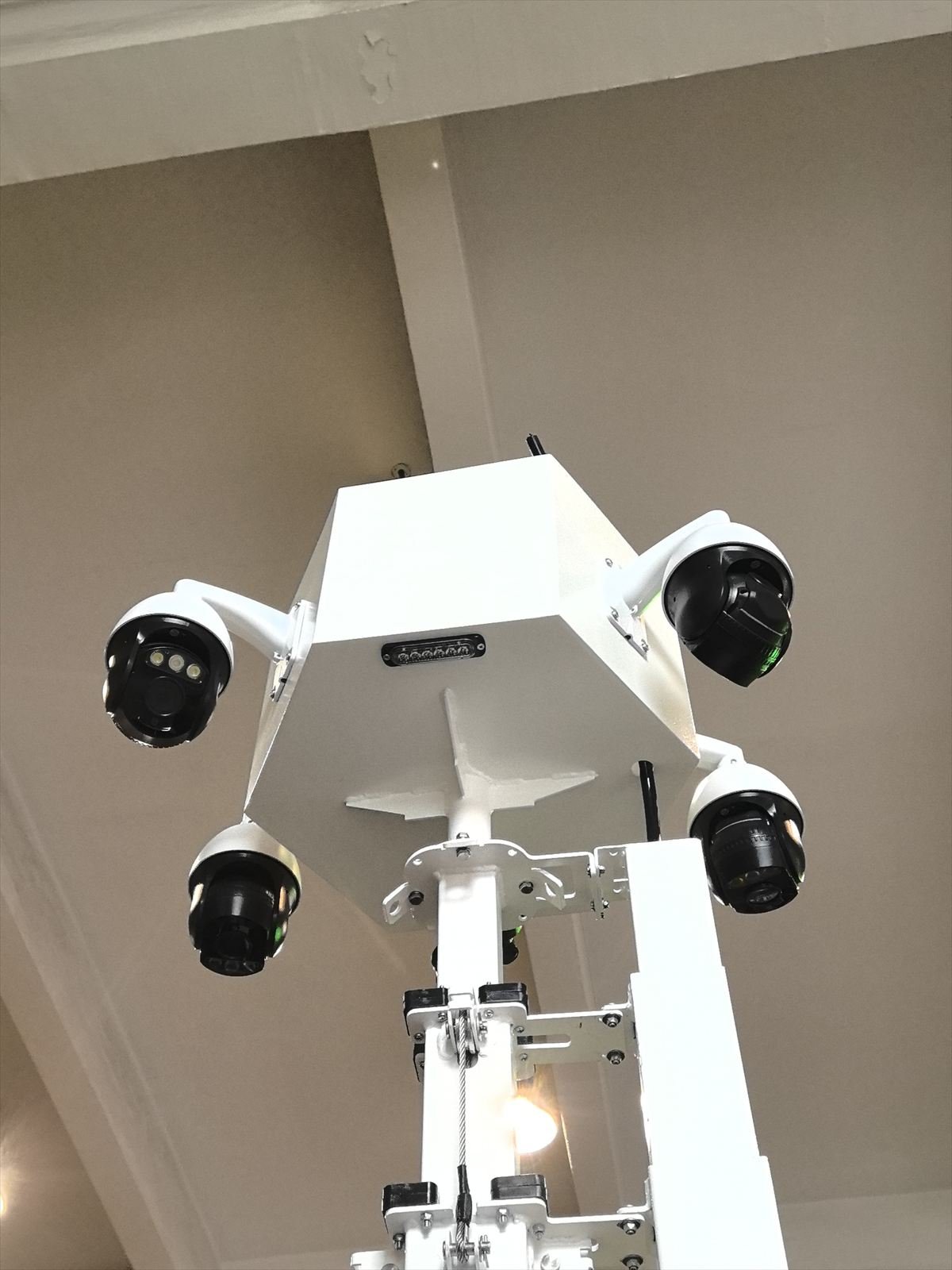
LUMTA solar surveillance trailers built in our factory. Cameras, panels, batteries and mast equipment vary by order; the S973 scope is confirmed in your quotation.




Define what the cameras need to observe
Provide a site sketch, the areas to monitor and the distances involved. Describe whether the task is general site observation, access-point monitoring or viewing a specific work area, and include night-time requirements and any obstructed sightlines.
Identify cameras you already own and ask which mounts, power interfaces and network connections are compatible. Confirm camera quantity, model, field of view and mounting positions in the proposed configuration. For existing CCTV equipment, review how customer-supplied cameras can be integrated with a solar surveillance trailer. A camera count alone does not establish complete site coverage.
Use the surveillance trailer selection guide and site survey checklist to prepare the inputs.
Agree the recording, remote access and network scope
Specify whether recording will be local, remote or both, the required retention period and who needs access. Ask the quotation to identify the recorder, storage, software, licences and alert functions included, optional or supplied by another party.
Check mobile coverage at the deployment location and confirm the proposed router, antenna and network compatibility. Identify who provides the SIM, data plan, subscriptions and ongoing service charges. A trailer configuration does not by itself establish that these services or a staffed monitoring service are included.
For an existing installation, compare the mobile surveillance trailer and fixed CCTV options before choosing the deployment approach.
Size the energy package around the monitoring load
Include the cameras, recorder, router, communications equipment and any auxiliary lights in the load list. Provide daily operating hours, the required reserve period, project location, season and known shading conditions.
Battery capacity stated in amp-hours needs the battery voltage and system arrangement before usable energy can be compared. Request the applicable battery specification and the assumptions used for a reserve estimate. Do not use a lighting-runtime figure from another configuration as the monitoring trailer’s guaranteed autonomy.
Ask which charging and backup arrangements are available for the proposed version and how they fit the site. Confirm the power package against the final equipment list.
Confirm the mast, site conditions and relocation plan
State the required working height, lifting preference, ground conditions and relocation frequency. Include temperature range, altitude, dust, wind exposure, coastal conditions and access limits in the configuration request.
Confirm transport dimensions, weight, loading method, stabilizer arrangement and towing requirements for the quoted unit and destination. Request its operating instructions and applicable setup limits before deployment.
Review the security and remote monitoring application or mining and quarry requirements for project preparation. The setup guide and maintenance checklist help organize questions; use the supplied equipment manuals for operation.
Request the documents and checks for the supplied system
Ask the quotation to state the agreed checks for the trailer, mast, solar and battery package, camera mounts, electrical interfaces and communications hardware. Identify any inspection photos, function demonstrations, manuals, packing records or spare-parts information you need before shipment.
Confirm which equipment is supplied by LUMTA and which is supplied or configured by others. Certificates and transport documentation should be checked for the named component, configuration and destination; a general product description does not establish certification for every complete system.
Request S973 technical documents or browse the resources. Compare the separate S963 model if its configuration is also relevant to your monitoring task.
Request an S973 project configuration and quote
Start with the quantity, destination, monitoring objective and operating schedule. Add the site layout or observation distance, existing camera equipment, network coverage, desired reserve period and delivery deadline if known.
The quotation should separate included equipment, optional items, customer-supplied components and recurring services. Confirm the component list, price basis, lead time, packing, setup responsibilities, warranty scope and after-sales support before ordering.
Request a Quote and include “S973” in your message. Review the surveillance trailer price factors to prepare the scope for comparison.
S973 surveillance trailer purchasing questions
Are four PTZ cameras included on every S973 order?
The supplied document describes a four-PTZ-camera package. Confirm camera quantity, model and supply responsibility for the version in your quotation; other listed options are not automatically the same package.
Does 4G control include a data plan or monitoring service?
Do not assume these are included. Confirm the network hardware, SIM and data plan, software, user access and recurring charges in the written supply scope.
Can battery amp-hours tell me the reserve period?
Not alone. Compare battery voltage and usable energy with the complete equipment load, operating schedule, solar conditions and reserve assumptions.
Is the S973 a solar lighting tower?
This page concerns the S973 surveillance trailer. If the main requirement is work-area illumination, compare the separate solar mobile light towers and specify any combined lighting and monitoring loads explicitly.