
A mobile light tower (also called a lighting tower, light plant or tower light) is a self-contained lighting unit: LED floodlights on a telescopic mast, mounted on a towable trailer, with its own power source. It brings bright, high-mounted light to construction sites, mines, road works, events and emergencies wherever there is no permanent lighting or grid power.
This guide explains how a light tower works, its main parts, the different types, and how to choose one. To see models, browse LUMTA mobile light towers by power type, or compare telescopic light tower mast options.
Already know what you need?
Send your application, quantity, destination and nightly hours for a configuration recommendation and quotation. Minimum order: one unit.
How Does a Mobile Light Tower Work?
The power system (an engine-generator, a battery bank, or both) supplies electricity to LED floodlights at the top of a telescopic mast. Raising the lamps several metres above the ground spreads light over a much wider area with less glare than ground-level lights. When the job moves, the mast is lowered and the trailer is towed to the next position.
Main Parts of a Light Tower
| Part | What it does | What to check |
|---|---|---|
| Trailer chassis | Carries all equipment; towed between sites | Axle, drawbar, brakes and lights for your road rules |
| Telescopic mast | Raises the lamps, typically to 7–9 m | Height, lifting method, rotation, wind rating |
| LED floodlights | Provide the light, usually four heads | Lamp power, optics, aiming |
| Power system | Diesel generator, solar + battery, or hybrid | Runtime, fuel or charging, noise |
| Stabilisers / outriggers | Keep the tower stable with the mast raised | Deployment space and ground conditions |
| Control panel | Starts the engine, switches lamps, raises the mast | Timers, dimming, remote monitoring |
Types of Mobile Light Towers
By power source
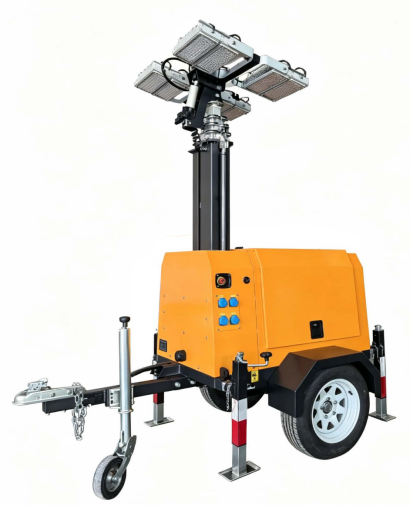
- Diesel light towers carry an engine-generator and run all night in any weather. LUMTA’s diesel range uses four 400 W LED lamps and a Kubota Z482 engine.
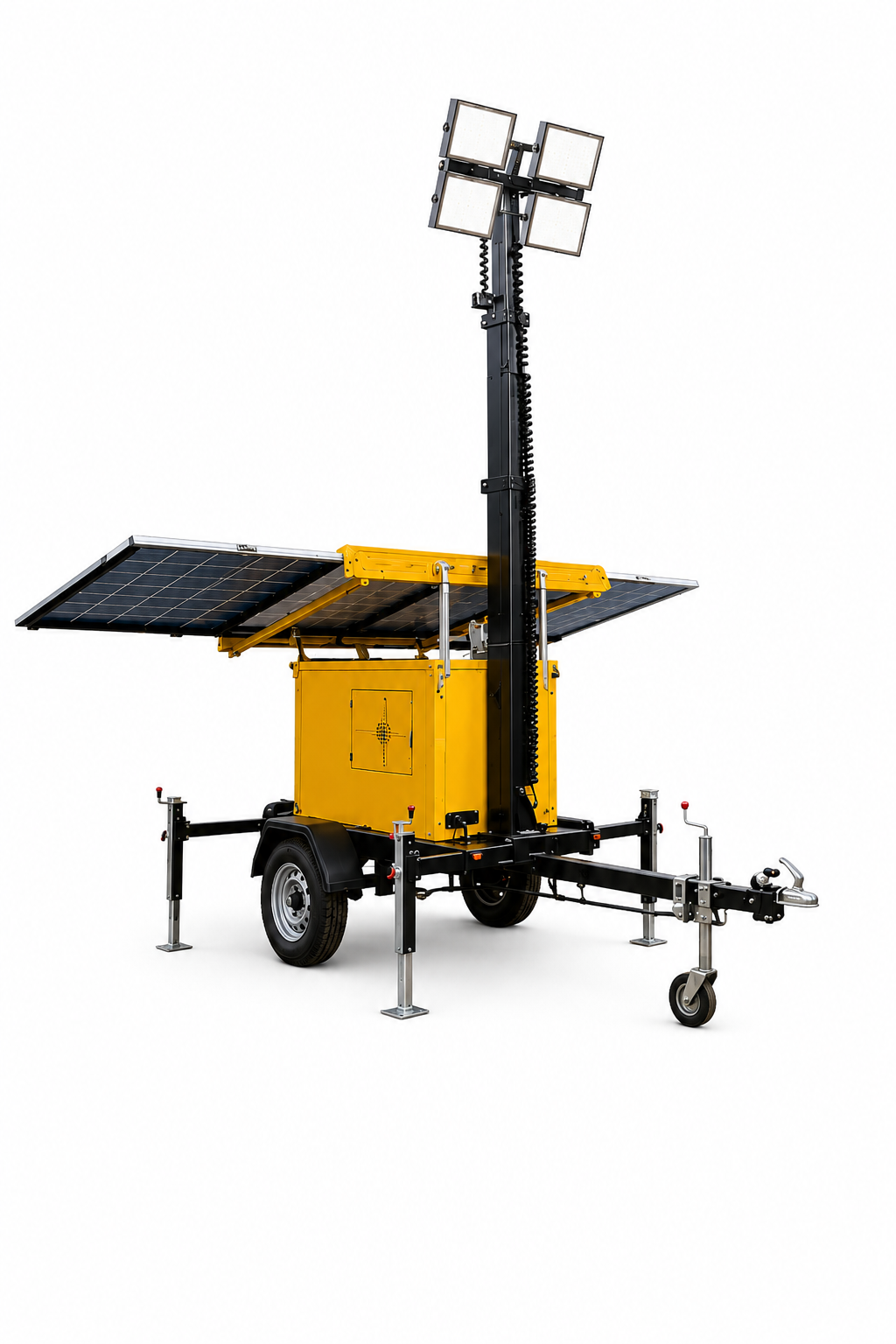
- Solar light towers charge a battery from solar panels by day and light by night with no fuel and almost no noise. The 4LT600M9AH1200 lists 4 × 150 W LED (84,000 lm), 3 × 470 W panels and 6 × 200 Ah batteries for 8 to 12 hours of light.
- Hybrid light towers run the lamps from a battery and start a generator only to recharge, cutting engine hours. The E4LT600M9AH1200 combines 4 × 150 W LED, 3 × 470 W panels, 6 × 200 Ah batteries, a 3 kW diesel generator and a 9 m mast.
By mast lifting method
| Mast type | LUMTA example | Best for |
|---|---|---|
| Manual winch | 4LT1600M9CC6.5KW, 9 m | Simple, low-maintenance units that stay in place |
| Electric | 4LT1600M9Z482, 9 m | Push-button setup without hydraulics |
| Hydraulic | LFNVP4000, 9 m | Fast, low-effort setup for frequent moves |
| Pneumatic | Custom build on request | Projects specifying an air-driven mast |
Compare them in detail in manual vs electric vs hydraulic light tower masts.
By size
Besides trailer towers there are compact units for small work zones: the LF6133 wheeled flood light lifts 600 W of LED light to about 4.8 m, the LF6125 tripod light weighs 8 kg, and the LF2970 loads itself onto a pickup.
Not sure which light tower fits your site?
Tell us the application, hours of light per night and destination. We will recommend a diesel, solar, hybrid or battery model and quote it from one unit.
Where Light Towers Are Used
- Construction and road works
- Mining and quarries
- Equipment rental fleets
- Oil and gas, pipelines and remote camps
- Events, car parks and temporary security
- Emergency, flood and disaster response
Demand is growing: Global Market Insights values the mobile light tower market at USD 6.7 billion in 2025, forecast to reach USD 12.1 billion by 2035 (market overview).
How to Choose a Light Tower
- Hours per night and fuel access: long shifts with easy refuelling favour diesel; sunny sites with limits on noise or fuel favour solar; long nights with uncertain sun favour hybrid.
- Area to light: mark the work zones and obstacles; see how many light towers you need.
- How often it moves: frequent moves justify a powered (electric or hydraulic) mast.
- Transport and destination: towing rules, container shipping and local voltage.
- Service and parts: engine service access, battery replacement and documents.
Read solar vs diesel vs hybrid light towers for a side-by-side comparison.
Frequently Asked Questions
What is a mobile light tower?
A mobile light tower is a self-contained lighting unit with LED floodlights on a telescopic mast, mounted on a towable trailer and powered by a diesel generator, a solar-charged battery or a hybrid of both. It lights work areas where there is no permanent lighting or grid power.
What is a light tower used for?
Night work on construction and road sites, mining and quarries, oil and gas, rental fleets, events and car parks, emergency and disaster response, and temporary security lighting.
How tall is a light tower mast?
Most trailer light towers use 7 m to 9 m telescopic masts. LUMTA’s trailer models use 7 m or 9 m masts, including the E4LT600M9AH1200 hybrid at 9 m, and the portable LF6133 lifts to about 4.8 m.
How long does a light tower run?
A diesel tower runs as long as its fuel lasts: usable fuel divided by fuel use per hour, for example 100 L at 2.0 L/h is about 50 hours. A solar tower runs from its battery; the 4LT600M9AH1200 lists 8 to 12 hours.
What is the difference between a light tower and a portable work light?
A light tower is a trailer unit with a tall mast and its own generator or battery system for large areas. A portable work light is smaller and hand-moved, for confined or short tasks; see portable work light vs mobile light tower.
Get a mobile light tower quote
Tell us your application (construction, mining, events, rental), power preference (diesel, solar or hybrid), quantity and destination port. FOB or CIF quote within 24 hours, MOQ 1 unit, production 45–60 days.