
A portable light tower can be anything from a 20 kg case light to a one-tonne trailer with a 7.5 m mast. Choosing the wrong class is the most common mistake: a trailer tower that cannot reach the work area, or a cart light that cannot cover the site. This guide shows how to choose a portable light tower in seven steps, with a checklist you can send to any supplier.
We are LUMTA, the mobile lighting brand of Zhejiang Longfa Lighting Co., Ltd. in Yueqing, Zhejiang, China. We build portable work lights and diesel, solar, hybrid and battery light towers, and the minimum order is one unit. The examples below use our own models because we can confirm their figures.
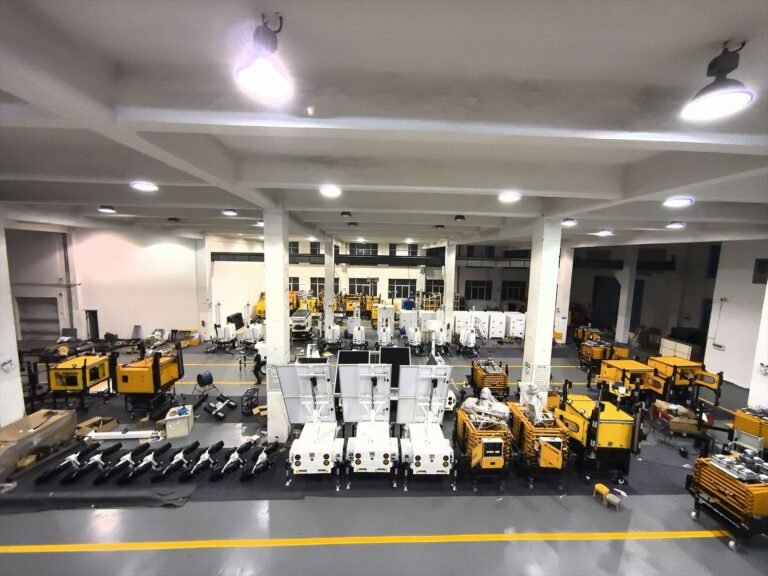
The three classes of portable light tower
“Portable” covers three very different machines. Decide which class fits your site before you compare brands or prices.
| Class | How it moves | Typical mast | LUMTA examples | Best for |
|---|---|---|---|---|
| Case and hand-carried lights | Carried or pulled like luggage | 1.9–2.3 m | LF6108 (20 kg case), LF6121 (23 kg, built-in generator) | Repairs, inspections, emergency kits, indoor work |
| Wheeled work light carts | Rolled by one or two people | 4.5–5 m | LF6132 (50 kg, 5 m electric mast), LF6110D (75 kg, 4.5 m pneumatic mast), LF6133 (4.8 m automatic mast) | Railway works, maintenance yards, events, flood response |
| Towable light towers | Towed by a vehicle or lifted by crane | 7–10 m | D95x diesel, S97x solar, E855 battery (10 m hydraulic mast) | Construction, mining, roadworks, rental fleets |
There are also special formats. The LF2970 stands on four electric legs and loads itself onto a pickup in about 3 minutes. Skid-mounted towers drop the wheels altogether for mine sites where units are moved by crane or forklift.
Step 1: Start with the area and the hours
Write down how large the work area is, what work happens there and how many hours of light you need each night. A cart light that lights a 30–50 m radius is enough for a track repair. A road project or a mine pit usually needs several towable towers. To estimate the number of units, see how many light towers you need.
Step 2: Choose the power source
- Gasoline generator. Common on small and cart-mounted units because the generator is light. LF6132, LF6121 and LF2970 use gasoline generators.
- Diesel generator. Standard on towable towers for long shifts, because diesel engines run longer on a tank and fuel is easy to find on construction and mine sites. See diesel light towers.
- Solar and battery. No fuel, no engine noise and no exhaust on site. Runtime depends on sun hours and battery size. See solar light towers and battery light towers.
- Hybrid. A battery does most of the work and a generator starts only when needed, so the engine runs fewer hours. See hybrid light towers.
- Mains. Many cart lights, such as LF6110D and LF6133, can also run on 220/230 V mains for long-term lighting.
For a side-by-side comparison, read solar vs diesel vs hybrid light towers.
Step 3: Pick the mast height and how it is raised
Higher masts spread light over a larger area with less glare at ground level, but they add weight and need more stability. Portable masts range from 1.9 m on a case light to 10 m on the E855.
Masts are raised by hand winch, electric winch, hydraulics or compressed air. A pneumatic mast is fast: the LF6110D mast reaches 4.5 m in about 30 seconds. Manual masts are simple and cost less; electric and hydraulic masts save time when towers move every shift. Our mast comparison explains the trade-offs.
Step 4: Compare light output in lumens and lux, not just watts
LED wattage tells you power use, not how much light reaches the ground. Ask for:
- Total lumens. For example, LF6110D gives 4 × 15,000 lm and LF2970 gives 320,000 lm.
- Coverage at a stated light level. Ask for the area lit at a stated average lux, and whether the figure is measured or calculated.
- Lamp aiming. Lamps that tilt and turn on their own let one unit cover several work zones.
Compare suppliers at the same light level. A coverage figure without a lux value cannot be compared.
Step 5: Check runtime and fuel use
For fuel-powered units, runtime is usable fuel divided by fuel use per hour. A larger tank means fewer refuelling trips on night shifts. For a worked table, see how long a diesel light tower runs. To compare published fuel-use examples, see light tower fuel consumption.
For solar and battery units, ask for the runtime with all lamps on, the battery energy in kWh and how many sun hours are needed for a full charge. Our 4LT600M9AH1200 solar tower lists up to 20 hours from 6 × 200 Ah batteries; ask how that changes with the season at your site.
How much does a light tower weigh?
A light tower weighs anywhere from about 20 kg to over 1 tonne, depending on its class. Hand-carried case lights weigh 20–23 kg, wheeled carts 50–75 kg and towable trailer light towers roughly 500 kg to 1,050 kg. The table lists the weights of our own models.
| Model | Class | Weight | How it moves |
|---|---|---|---|
| LF6108 | Case light | 20 kg | Carried by one person |
| LF6121 | Case light with built-in generator | 23 kg | Carried by one person |
| LF6132 | Wheeled cart | 50 kg | Rolled by hand |
| LF6110D | Wheeled cart | 75 kg | Rolled by hand |
| 4LT1600M9BAT8KW | Diesel trailer tower, 9 m hand-crank mast | 520 kg | Towed by a pickup or small truck |
| 4LT1600M9Z482 | Diesel trailer tower, 9 m electric mast | 860 kg | Towed by a vehicle |
| 4LT600M9AH1200 | Solar trailer tower | 1,180 kg | Towed by a vehicle |
| LFNVP4000 | Diesel trailer tower, 9 m hydraulic mast | About 1,200–1,360 kg (depending on engine) | Towed by a vehicle |
Check the towing capacity of your vehicle and local trailer rules before choosing a towable unit. For a model list by power source, see portable light towers for sale.
Step 6: Plan transport, setup and stability
- Weight and moving. Cart lights such as LF6132 (50 kg) and LF6110D (75 kg) roll by hand. Towable towers such as our 4LT600M9AH1200 (1,180 kg) and 4LT1600M9Z482 (860 kg) need a vehicle, towing equipment and road-legal lights where they travel on public roads.
- Wind. Ask for the wind rating with the mast fully raised. Our D95x diesel and S97x solar towers are rated for 20 m/s (72 km/h, Beaufort 8).
- Shipping. If you import, ask how many units fit in a container. Our D95x and S97x towers ship 8 units per 40 ft container or 4 per 20 ft container.
- Ground and setup. Check stabilizer legs, the space needed when deployed and whether the unit can work on uneven ground.
Step 7: Compare the total cost, not only the price
A cheaper tower can cost more over its life if it uses more fuel, needs more service or sits idle waiting for parts. Compare purchase price, fuel or charging cost, maintenance, spare parts, transport and downtime. Our light tower price guide lists the cost factors. If you are importing for the first time, read how to buy mobile light towers from China.
Ready to compare models? See all LUMTA mobile light towers: diesel, solar, hybrid and battery.
Checklist: what to send a supplier
| Item | What to tell the supplier |
|---|---|
| Application | Type of work, area size and site conditions |
| Class | Case, wheeled cart or towable tower |
| Power | Gasoline, diesel, solar, battery, hybrid or mains; local voltage and frequency |
| Lighting hours | Hours per night and nights per week |
| Mast | Required height and lifting method |
| Light output | Required light level (lux) over the work area |
| Transport | How the units will move on site and how they will be shipped |
| Quantity and destination | Number of units, destination port or city and trade term (EXW, FOB or CIF) |
Our quote information checklist goes into more detail. To browse models, see portable light towers for sale and portable work lights.
Ready to buy? Compare our portable mobile light towers for sale: hand-push, compact 7 m, towable 9 m diesel and solar models, MOQ 1.
Portable light tower FAQ
Do portable light towers use diesel or gasoline?
Both. Small and cart-mounted units usually use a gasoline generator because it is lighter. Towable towers usually use diesel for longer runtime. Solar, battery and mains-powered units use no fuel on site.
How much fuel does a light tower use per hour?
It depends on the engine, the lamp load and whether other equipment is plugged in. Compare suppliers at the same load. Our fuel consumption page shows published examples and how to log your own unit.
How much does a portable light tower cost?
Price depends on the class, power source, mast type, lamp output and options such as remote control. A case light and a towable hydraulic tower are very different machines. Send your site details for a quotation, and see our price guide for the cost factors.
How high should the mast be?
Cart lights with 4.5–5 m masts suit smaller work areas; the LF6110D, for example, covers a 30–50 m radius. Large open sites such as roadworks and mines usually use towable towers with 7–10 m masts.
How fast can a portable light tower be set up?
Pneumatic and electric masts are the fastest. The LF6110D mast rises to 4.5 m in about 30 seconds, and the LF2970 self-loads onto a pickup in about 3 minutes.
How much does a portable light tower weigh?
It depends on the class. Case lights weigh about 20–23 kg (LF6108 20 kg, LF6121 23 kg). Wheeled carts weigh 50–75 kg (LF6132 50 kg, LF6110D 75 kg). Towable trailer towers weigh about 500 kg to 1.4 tonnes: the 4LT1600M9BAT8KW is 520 kg, the 4LT1600M9Z482 860 kg, the 4LT600M9AH1200 solar tower 1,180 kg and the LFNVP4000 about 1,200–1,360 kg. Towable units need a vehicle and towing equipment.
What is the minimum order and production time?
Our minimum order is one unit. For D95x diesel and S97x solar towers, production takes 45–60 days after the deposit is received.
Comparing fuel options? See our hybrid light tower guide: how solar-diesel hybrids work, fuel savings and the E4LT600M9AH1200.
Get a recommendation
Send the work area, lighting hours, power available and quantity. We will recommend a model and quote.
Ready to move from research to shortlisting? Browse our portable light towers for sale and read the mobile light tower price guide for buyers to understand every cost factor.